
Volunteer scheduling software is the difference between a GOTV weekend that runs like a command center and one that falls apart at 8am when your top canvasser doesn't show. For campaigns running city council or state legislative races, the right tool doesn't just collect signups — it fills shifts, sends reminders, tracks no-shows, and gives you real-time visibility into who is actually in the field. This guide covers what to look for, how it compares to the alternatives, and which tools are built for campaigns versus everything else.
What Is Volunteer Scheduling Software?
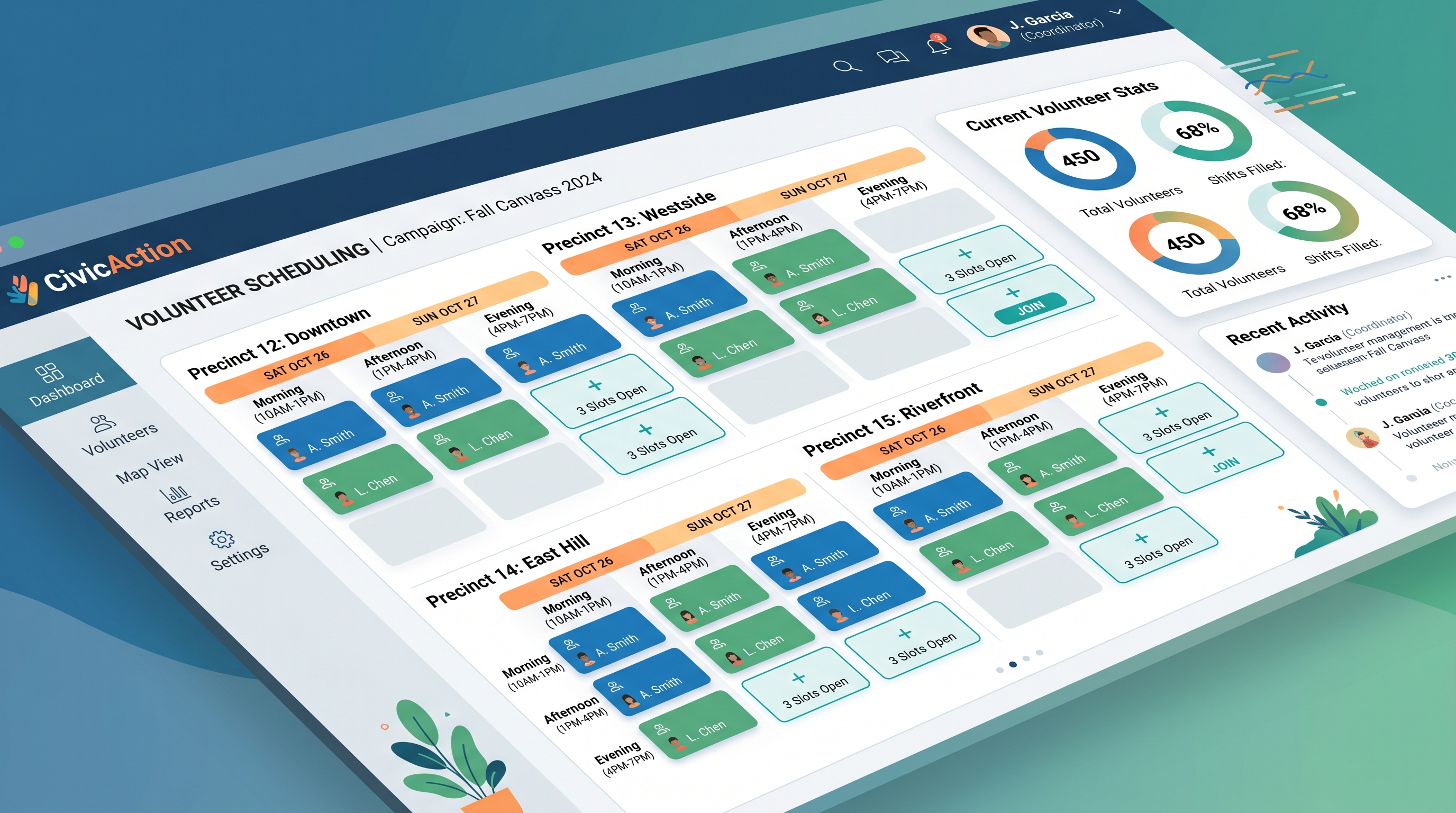
Volunteer scheduling software is a platform that lets campaign staff build shift schedules, open those shifts to volunteers for self-signup, and automate the reminders and confirmations that keep no-show rates low. At the campaign level, it connects to your broader volunteer management system — handling the operational layer so coordinators aren't manually texting 80 people the night before a canvass.
The best volunteer scheduling tools for campaigns do four things:
- Open and fill shifts fast — volunteers see what's available and claim a spot without coordinator friction
- Automate reminders — email or text confirmation before the shift, reducing cold no-shows
- Surface data in real time — how many slots are filled, who confirmed, who hasn't responded
- Connect to your field ops stack — syncing with your CRM, email campaigns, and volunteer tracking app so nothing lives in a silo
The Real Problem: GOTV Weekends Break on Scheduling
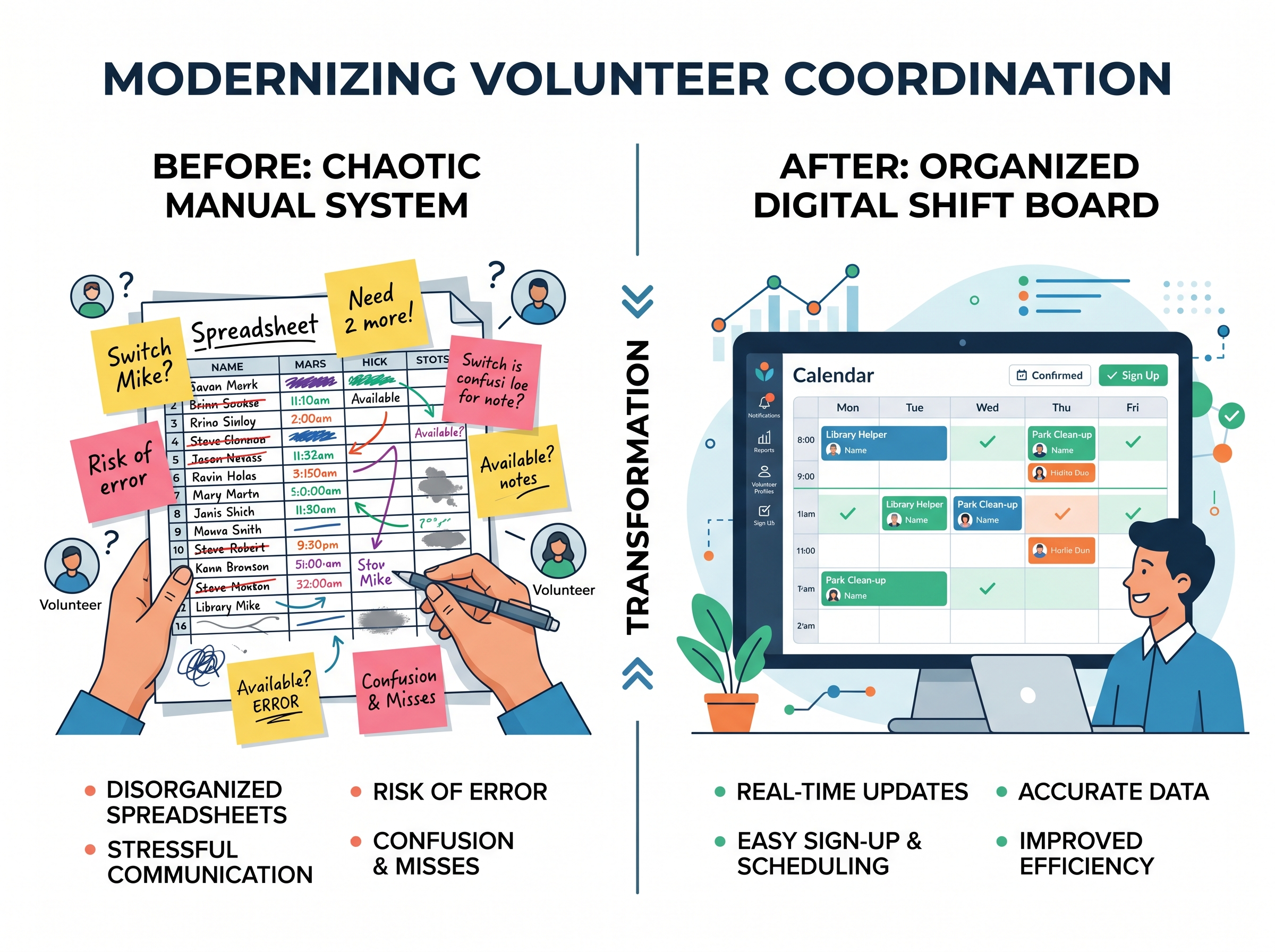
Here's the scenario every campaign manager knows. It's the Saturday before Election Day. You've got 14 canvass shifts scheduled across six precincts. Your coordinator published the shift slots on a Google Sheet two weeks ago. Some volunteers signed up in the sheet; others texted a field organizer directly; a few said "yes" in the campaign Slack. Nobody confirmed.
By 9am, three shifts are missing four people each. You're burning coordinator time on a phone tree. Meanwhile, doors aren't getting knocked.
This is the spreadsheet problem — and it's not a volunteer enthusiasm problem. The volunteers exist. The capacity is there. What's missing is a structured system that owns the scheduling workflow from slot creation to day-of confirmation.
Research backs this up: volunteer no-show rates for unconfirmed shifts run significantly higher than for those with automated reminders.[1] One study from VolunteerHub found campaigns using automated shift reminders saw no-show rates drop by 29%.[2] The math is simple — every filled shift on GOTV weekend is more doors per hour, more conversations, more votes.
A dedicated volunteer scheduling app changes the equation. Instead of a passive link to a spreadsheet, volunteers get an active process: sign up, confirm, get reminded, check in. Coordinators get a live view of shift fill rates instead of counting rows in a sheet.
Key Features to Look for in Campaign Scheduling Software
Not all volunteer scheduling software is built for campaign conditions. Most tools are designed for nonprofits running once-a-year events — not for operators managing 50-shift GOTV weekends under deadline pressure. Here's what the campaign context actually demands:
Shift Reminders and Automated Confirmations
The most important feature. A tool that sends an email (or better, a text) 24 hours before a shift and asks for confirmation will cut no-shows faster than any other lever. Look for multi-stage reminders: initial confirmation, day-before reminder, morning-of nudge.
Availability Collection
Before you build a shift calendar, you need to know when your volunteers are free. Good scheduling tools include an availability survey or intake form so coordinators can match volunteer windows to shift needs — instead of building a schedule and hoping for the best.
Multi-Event and Multi-Shift Management
A state legislative race might run 30+ events between now and Election Day. Your tool needs to handle parallel shift tracks, recurring events, and different volunteer pools without requiring a spreadsheet for each. If you're running field ops across multiple precincts simultaneously, this is non-negotiable.
CRM and Email Integration
Scheduling lives in a larger data environment. If a volunteer confirms a shift, that action should be visible in your volunteer tracking system — feeding into engagement scores, informing your follow-up emails, and contributing to your activation funnel. Standalone scheduling tools that don't connect to the rest of your stack create data gaps that hurt you at reporting time and on GOTV day.
Gamification and Engagement Layers
Campaigns that treat scheduling as a transactional process ("sign up, show up, done") miss the motivational layer. Leaderboards, shift streaks, and engagement milestones make volunteering feel like progress toward a goal — and drive repeat shifts from your most reliable people. This is why purpose-built campaign platforms include these features where generic scheduling tools don't.
Free vs. Paid Options
For campaigns with tight budgets, a free volunteer scheduling app can cover basic shift creation and signup. Tools like SignUpGenius offer free tiers that work for low-complexity needs. The tradeoff: free tools typically lack automation, analytics, and integration — meaning they solve the signup problem but not the show-up problem. Most campaigns running more than 10 events will hit the limits of free tools quickly.
Volunteer Scheduling Software Comparison: 5 Tools for Campaigns
| Tool | Campaign-Specific | Scheduling | Reminders | CRM/Email Integration | Starting Price |
|---|---|---|---|---|---|
| Vox Populus | ✅ Yes | ✅ Full shift management | ✅ Email (SMS coming) | ✅ Native | $100/mo |
| Mobilize | ✅ Yes | ✅ Strong | ✅ Email + SMS | ⚠️ Limited | Free / custom |
| VolunteerHub | ❌ Nonprofit-first | ✅ Strong | ✅ CRM integration | Paid (custom) | |
| Better Impact | ❌ Nonprofit-first | ✅ Solid | ⚠️ Limited | Paid (custom) | |
| SignUpGenius | ❌ Generic | ⚠️ Basic | ⚠️ Basic | ❌ No | Free / $9.99/mo |
Vox Populus
Vox Populus is purpose-built for political campaigns — not adapted from a nonprofit tool or bolted onto a generic event platform. The shift management module connects directly to the volunteer recruitment and analytics layers, so fill rates, attendance, and engagement scores all live in the same system. Gamified leaderboards give coordinators a retention lever that generic scheduling tools don't offer. At $100/month for beta access, it's designed for city, county, and state legislative races where operational overhead is real but budget isn't unlimited.
Mobilize
Mobilize is the closest direct competitor on campaign focus. It's widely used by progressive campaigns and offers solid scheduling with event creation, RSVPs, and email reminders. Its strength is network integration — volunteers can discover events through a broader Mobilize community. The trade-off: it's less strong on the analytics and engagement layer, and CRM integration requires additional configuration or workarounds.
VolunteerHub
A well-regarded volunteer shift scheduling software platform, but its DNA is nonprofit-first. It's strong on scheduling, automated communications, and hour tracking — features that make sense for organizations running ongoing programs. Campaign operators will find some friction around the political-specific workflows (GOTV, field ops, precinct-level reporting) that platforms like Vox Populus handle natively. For campaigns that also have a nonprofit arm or need a more established platform, it's worth evaluating.
Better Impact
Better Impact offers a comprehensive volunteer management suite including scheduling, check-in, and communications. Like VolunteerHub, it's designed for nonprofits and large volunteer programs — which means robust functionality and a longer implementation curve. Campaigns running lean operations may find the overhead doesn't match their pace. Strong if you need deep reporting and have a coordinator dedicated to the platform.
SignUpGenius
The most widely known free volunteer scheduling app — and the most commonly cited as "what we used before we had a real system." SignUpGenius works for simple shift creation and volunteer self-signup, but automation is limited on free tiers, and there's no native integration with campaign CRMs or analytics platforms. Fine for a small race with predictable scheduling needs; a bottleneck for anything approaching GOTV scale.
What This Looks Like in Practice: A City Council Race on GOTV Weekend
The scenario: A first-time city council candidate in Sacramento, CA. 18 precincts. Four days of canvassing before Election Day. 120 volunteers on the list, but field coordinator knows from experience that 60–70 will actually show.
The old way: Google Sheet with shift slots. Volunteers added their names. Coordinator texted reminders manually. Day-of: three precincts short-staffed, two precincts over-capacity. Two hours of reactive logistics instead of field work.
With volunteer scheduling software:
- Coordinator builds four days of shifts inside the platform — 6 precincts per day, 3–5 volunteers per precinct
- Volunteers receive personalized shift invites based on their availability and prior engagement history
- 24-hour email reminder goes out automatically; volunteers who haven't confirmed get a follow-up nudge
- Morning of: coordinator sees a live fill-rate dashboard. Three slots still open in Precinct 7. Sends a targeted fill request to the 12 volunteers in the waitlist pool — two confirm within an hour
- At end of day, attendance is logged automatically, feeding the leaderboard and informing who gets priority shift invites next week
The coordinator spent 40 minutes on scheduling logistics instead of four hours. The field team hit 94% shift fill rate across all four days.
This is what purpose-built volunteer management software for political campaigns actually delivers — not just a way to collect signups, but an operational layer that keeps the ground game running under pressure.
Volunteer Scheduling Software FAQs
What is volunteer scheduling software?
Volunteer scheduling software is a platform that lets organizations — including political campaigns — create shift schedules, collect volunteer signups, send automated reminders, and track who shows up. For campaigns, it replaces spreadsheets and manual outreach with a system that automates the logistics layer between signing up and showing up.
Is there a free volunteer scheduling app for campaigns?
Yes. SignUpGenius offers a free tier that covers basic shift creation and volunteer signup. Mobilize also offers free access for political campaigns at certain tiers. However, free tools typically lack automated reminders, analytics integration, and the campaign-specific features that reduce no-shows at scale. For campaigns running more than 10 events, a paid tool usually pays for itself in coordinator time saved.
What's the difference between a volunteer scheduling app and volunteer management software?
Volunteer scheduling software focuses on shift creation, signup, and reminders — the logistics of who is working when. Volunteer management software is broader: it includes scheduling but also handles volunteer onboarding, communication, analytics, and engagement over time. For campaigns, you generally want both — or a platform that integrates them. See our guide to volunteer management software for political campaigns for the full picture.
What features matter most for campaign volunteer scheduling?
Automated shift reminders (the single biggest driver of no-show reduction), real-time fill-rate visibility, multi-event management across precincts or dates, and integration with your email and CRM stack. For campaigns specifically, leaderboards and engagement scoring are also valuable because they turn one-time shift signups into repeat volunteers — which is the real retention problem in field ops.
How do I reduce volunteer no-shows for canvassing shifts?
Three levers: confirm early (ask for commitment at signup, not just RSVP), remind consistently (24-hour and morning-of reminders have the biggest impact), and build a waitlist (fill cancellations from an active backup pool). Automated scheduling tools handle all three without manual coordinator overhead. Campaigns using automated confirmation workflows have reported no-show rate reductions of 20–30% compared to manual follow-up.[2]
How is Vox Populus different from other volunteer scheduling tools?
Vox Populus is built specifically for political campaigns — not adapted from a nonprofit or generic events platform. It combines shift scheduling, email campaigns, analytics, and gamified leaderboards in a single system designed for city, county, and state legislative races. The result is a tighter loop between scheduling, volunteer engagement, and field performance data — without stitching together multiple tools.
The Bottom Line on Volunteer Scheduling Software
Campaign coordinators don't lose GOTV weekends for lack of volunteers. They lose them in the gap between "signed up" and "showed up" — a gap that spreadsheets and generic signup tools aren't designed to close.
The right volunteer scheduling software closes that gap with automation, real-time data, and a volunteer experience that makes showing up easy. For campaigns running city council through state legislative races, the difference between a tool built for nonprofits and one built for campaigns shows up directly in shift fill rates, coordinator time, and ultimately — doors knocked.
Vox Populus was built for this exact problem. See how it works →
Andrew Blase writes about campaign operations and political technology for Vox Populus. More from Andrew: Field Ops Software: How Distributed Campaigns Coordinate Turf, Shifts, and Reporting