

Last updated May 2026
Someone signed up to volunteer for your campaign at 8pm on Tuesday. They filled out the form, confirmed their email, and closed the tab feeling like they'd done something meaningful. By Thursday morning, they haven't heard back. By Saturday, life has moved on and so have they.
This is the onboarding gap — and it is where most campaigns bleed the volunteers they worked hard to recruit.
The 48-hour window after signup is the highest-leverage moment in your entire volunteer operation. Campaigns that close the gap between recruitment and first shift with a structured onboarding sequence retain significantly more volunteers than those relying on volunteers to self-activate. The playbook below shows you exactly how to do it.
The Onboarding Gap: Why Campaigns Lose 30–50% of Signups Before the First Shift
Most campaigns treat volunteer onboarding as a confirmation email. Someone fills out the signup form, they get an automated "Thanks for signing up!" reply, and then — nothing. The campaign is busy. The organizer is running field. The follow-up happens whenever someone has a moment.
That moment usually never comes, or comes too late.
Research on volunteer behavior consistently shows that motivation to act is highest immediately after the decision to commit and decays sharply over the following 48–72 hours.[1] Political campaigns are not unique here — every behavioral science framework from donation psychology to habit formation confirms that the window between stated intention and action is narrow, and external friction closes it fast.
For a city council or state legislative race, that math is brutal. If you recruit 200 volunteers over a six-week period and half of them never complete a first shift, you are running field ops on 100 people. The 100 who disappeared were not less motivated when they signed up — they were just not pulled into action before life got in the way.
The good news: this is an ops problem, not a people problem. The campaigns that retain volunteers aren't more inspiring — they're more organized. They have a system that meets volunteers at their peak motivation and pulls them into their first action before that energy dissipates.
That system is a structured 48-hour onboarding sequence.
Why the First 48 Hours Are Decisive
Think about what a new volunteer is doing in the 48 hours after they sign up.
They just decided they want to help. They don't yet know what that help looks like. They haven't been to an event. They don't know the organizers, the other volunteers, or what a typical shift actually involves. They have goodwill and no structure.
This is the moment to give them both a relationship and a next action.
What they are not doing: waiting around to be convinced. The decision is made. What they need is frictionless access to a concrete first step that confirms their decision was the right one.
Behavioral research on civic participation shows that volunteers who complete a first action within the first week of signup are dramatically more likely to become repeat volunteers than those who don't act in that window.[2] The first shift is not just a shift — it is the activation event that converts a name on a list into a member of the team.
Campaigns that understand this stop asking "how do we get volunteers to show up more?" and start asking "how fast can we get a new signup to their first shift?" The answer, for a well-organized campaign, is 48 hours.
The Campaign Volunteer Onboarding Sequence: A Step-by-Step Playbook
Here is the complete onboarding sequence, from the moment someone submits the signup form to the moment after their first shift.
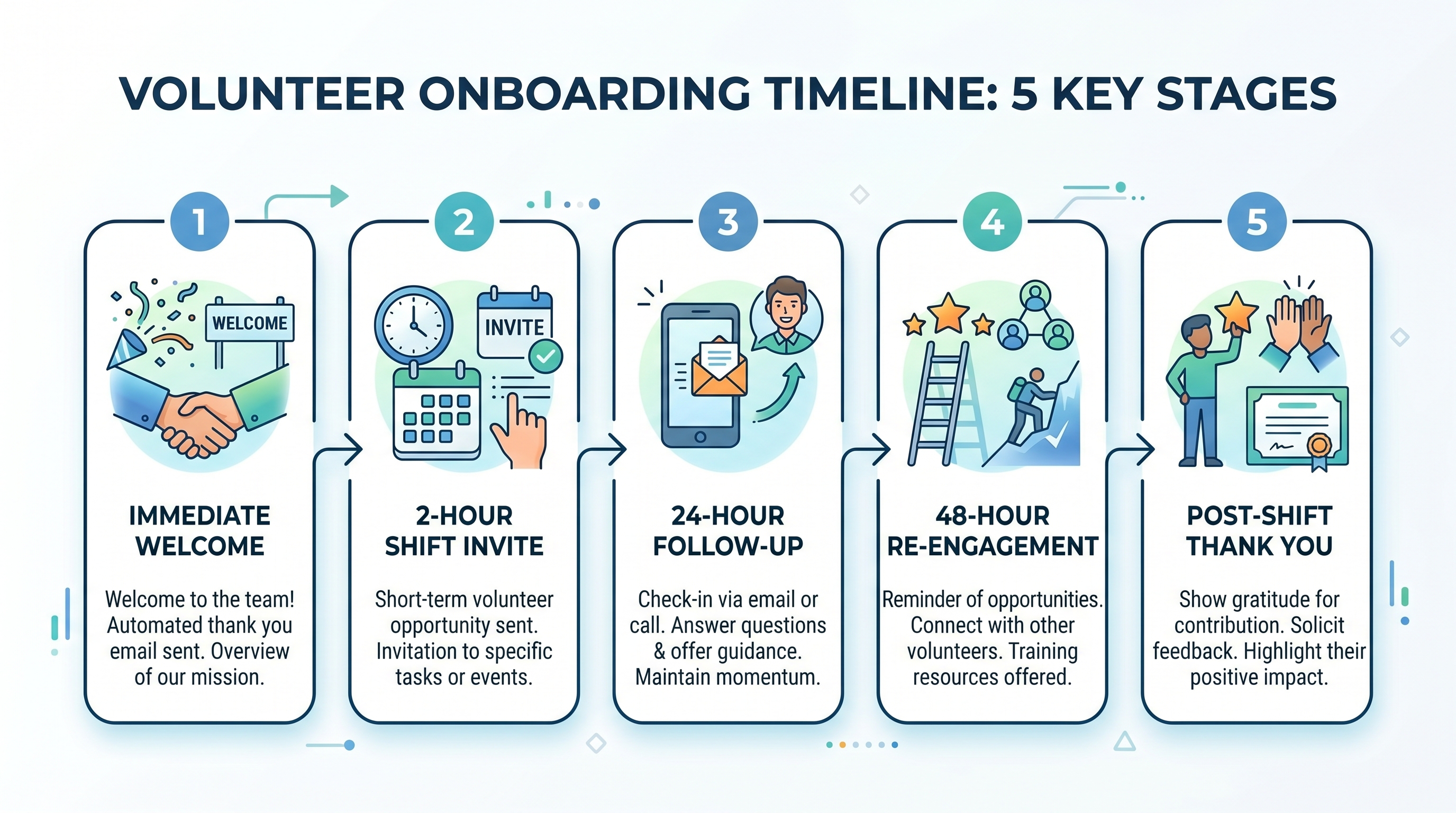
Immediate: The Automated Welcome Message
This fires the moment the signup form is submitted — not an hour later, not the next morning. Immediately.
A strong welcome message does five things:
- Confirms they're in. Name them, confirm the campaign, confirm the candidate.
- Names who they'll be working with. "You'll be working with our field team, led by [Organizer Name]." Human names make it real.
- Explains what they'll be doing. "Volunteers on our team canvass neighborhoods, make phone calls, and staff events. Most first shifts are 2–3 hours." Specifics reduce anxiety.
- Sets expectations for the first event. "At your first shift, you'll get a brief orientation, meet the team, and get everything you need to hit the ground running."
- Ends with one action, not five. A single link or button: "Schedule your first shift."
What it does not include: the candidate's full biography, a six-paragraph policy explainer, links to three different sign-up forms, or a request to donate. The welcome message has one job — move them to the next step.
Within 2 Hours: The First Shift Invite or Survey
If the welcome message got the read but not the click, the second touchpoint goes out within two hours.
This is not a newsletter. It is not another welcome. It is a direct, specific invitation: here are three upcoming shifts, pick one that works.
If you don't yet have enough information to match them to a shift, send a brief two-question survey: "What type of volunteering interests you most?" and "When are you typically available?" Keep it to two questions. This is not a background check — it is a routing mechanism.
The critical thing: this message should feel like an invite from a person, not a drip from a CRM. "We'd love to have you at our canvassing shift this Saturday at 10am in [Neighborhood]. Reply to this email to confirm or click below to choose another time." Low friction, personal tone, one ask.
Within 24 Hours: The Personal Follow-Up
Automated sequences do a lot of the work. But somewhere in the first 24 hours, a human touch needs to come through — even if it is an email written to sound like it came from a person.
This can be from the lead organizer, the field director, or the campaign manager. It is short: three sentences. "Hey [Name], I'm [Organizer Name] and I lead our volunteer team. I saw you signed up and wanted to personally reach out — we'd love to have you at our canvass this weekend. Any questions? Just reply."
If your campaign runs at scale and you are managing hundreds of new signups per week, this touchpoint can come from a template. But it should read like a note, not a newsletter.
This step serves a second function: it puts a name on the campaign. Volunteers show up for people, not organizations. When someone knows who they're reporting to — even just by name — it creates social accountability that a generic confirmation email cannot.
Within 48 Hours: The Re-Engagement Message
Some volunteers will not respond to the first two touchpoints. Life happened. The email got buried. They meant to click but didn't.
The 48-hour re-engagement message is your last best chance before enthusiasm fades below actionable level.
Keep it short and low-friction. Lower the ask. Instead of "here are three shifts," offer one: "There's still time to join us this Saturday. It's just a 2-hour canvass and we'll handle everything — just show up." Or ask a simple question: "Still interested in getting involved? Just reply and I'll send you the details." Yes/no takes ten seconds.
The goal of this message is not guilt. It is access. Make it as easy as possible for someone who wants to help to take a single step.
After the First Shift: The Post-Shift Thank You and Next-Shift Invite
The first shift is not the end of onboarding — it is the most important moment in volunteer retention.
A volunteer who just finished their first shift is in the highest-engagement state they will ever be. They did something meaningful. They met the team. They probably got some positive reinforcement from organizers on the ground. The campaign is real to them now in a way it wasn't 48 hours ago.
This is the moment to send the thank you and the next-shift invite in the same message.
Name what they did. "You knocked 40 doors in [Neighborhood] today — that's real impact." Then make the next ask: "We're back out Saturday. Want to come back?" One click to RSVP.
This single message, sent within two hours of the shift ending, is the highest-leverage touchpoint in your entire volunteer communication strategy. Campaigns that nail it see first-shift-to-second-shift conversion rates significantly above average. Campaigns that send a generic "thanks for volunteering!" two days later do not.[3]
What to Include in a Volunteer Welcome Message
The welcome message template that performs best for city council and state legislative campaigns follows this structure:
Subject: Welcome to [Campaign Name] — here's what's next
Opening: Confirm the signup and express genuine appreciation. One sentence.
The team: Name the organizer they'll be working with. One sentence.
What they'll do: Two to three sentences on what volunteers actually do. Canvassing, phone banking, event staffing, literature drops — whatever is accurate. Avoid abstract language like "make a difference." Be specific.
What the first event looks like: "Your first shift is low-key. You'll get a 10-minute orientation, meet the rest of the team, and we'll pair you with an experienced volunteer. Most people say they wished they'd come sooner." Normalize the first shift.
The one action: A clear button or link to schedule a first shift. No other links competing for attention.
Signature: From a named person, not "The Campaign Team."
Total length: under 200 words. If you can say it in 150, say it in 150.
Common Volunteer Onboarding Mistakes
Front-loading too much information
New volunteers do not need to read your policy platform before their first shift. They signed up because something moved them — the candidate, the cause, the knock on their door. Trust that motivation. Give them the information they need to show up, nothing more.
Asking for commitment before giving value
Some campaigns include donation asks, volunteer driver requests, and training requirements in the onboarding sequence before the volunteer has attended a single event. This is premature. Earn the relationship at the first shift. The upsell comes later.
No follow-up after signup
This is the most common mistake. Sending a confirmation email and then waiting for volunteers to self-schedule is not a system — it is hoping. You will lose the majority of your signups this way. Every day of silence after signup is entropy working against you.
Missing the post-shift moment
The post-shift thank-you is one of the most consistently under-executed moments in political campaign volunteer management. Campaigns spend enormous energy recruiting volunteers and almost none celebrating the first shift. A 60-second email sent immediately after the shift is over returns more in retention than most other onboarding investments combined.
Using a generic volunteer management tool
General-purpose tools — Google Sheets, MailChimp lists, generic CRMs — can handle individual pieces of the onboarding sequence. But they don't trigger the sequence automatically, don't tie the signup event to the follow-up to the shift invite to the post-shift thank you. The result is a campaign where someone manually sends each email, which means those emails are sent late or not at all.
Tools That Support Campaign Volunteer Onboarding
When evaluating volunteer onboarding software for your campaign, look for platforms that handle these capabilities without manual stitching:
- Volunteer sign-up forms that capture the right information at the front end — availability, interests, contact preferences — and route new signups into the onboarding sequence automatically.
- Automated email sequences tied to signup events, not just broadcast lists. The 48-hour sequence described above only works at scale if the triggers are automatic.
- Shift scheduling that integrates with the email sequence. The first-shift invite needs to link directly to a real available shift, not a form that says "we'll be in touch."
- Volunteer analytics that show you where the sequence is working and where it is breaking down. Which touchpoint has the best open rate? Where are volunteers dropping off?
- Post-shift tracking that feeds back into the sequence. The post-shift thank-you and next-shift invite requires knowing who completed a shift and when.
For more on evaluating platforms, see our guides to volunteer recruitment software, volunteer scheduling software, and the best volunteer management software available for political campaigns.
Vox Populus is purpose-built for this workflow. The platform automates the full 48-hour onboarding sequence — welcome email, first-shift invite, personal follow-up, re-engagement message, post-shift thank you — without requiring manual intervention from the campaign team. New signups trigger the sequence automatically. Shift scheduling is integrated, so the first-shift invite links to real available slots. Volunteer analytics show open rates, shift completions, and drop-off points by step.
The platform also includes gamified leaderboards that give returning volunteers a visible recognition mechanism — something that significantly improves second-shift and third-shift conversion rates after the first shift is complete. For campaigns running city council, county, or state legislative races, where every volunteer hour counts, closing the onboarding gap by even 15–20% translates directly into more doors knocked and more votes turned out.
For campaigns planning to layer in SMS follow-up, Vox Populus has text messaging coming soon — see our overview of text message campaigns for political marketing for the current best practices on that channel. For a broader look at what modern volunteer infrastructure looks like, see our guide on volunteer management software for modern political campaigns and our comparison of the best volunteer management software options available today.
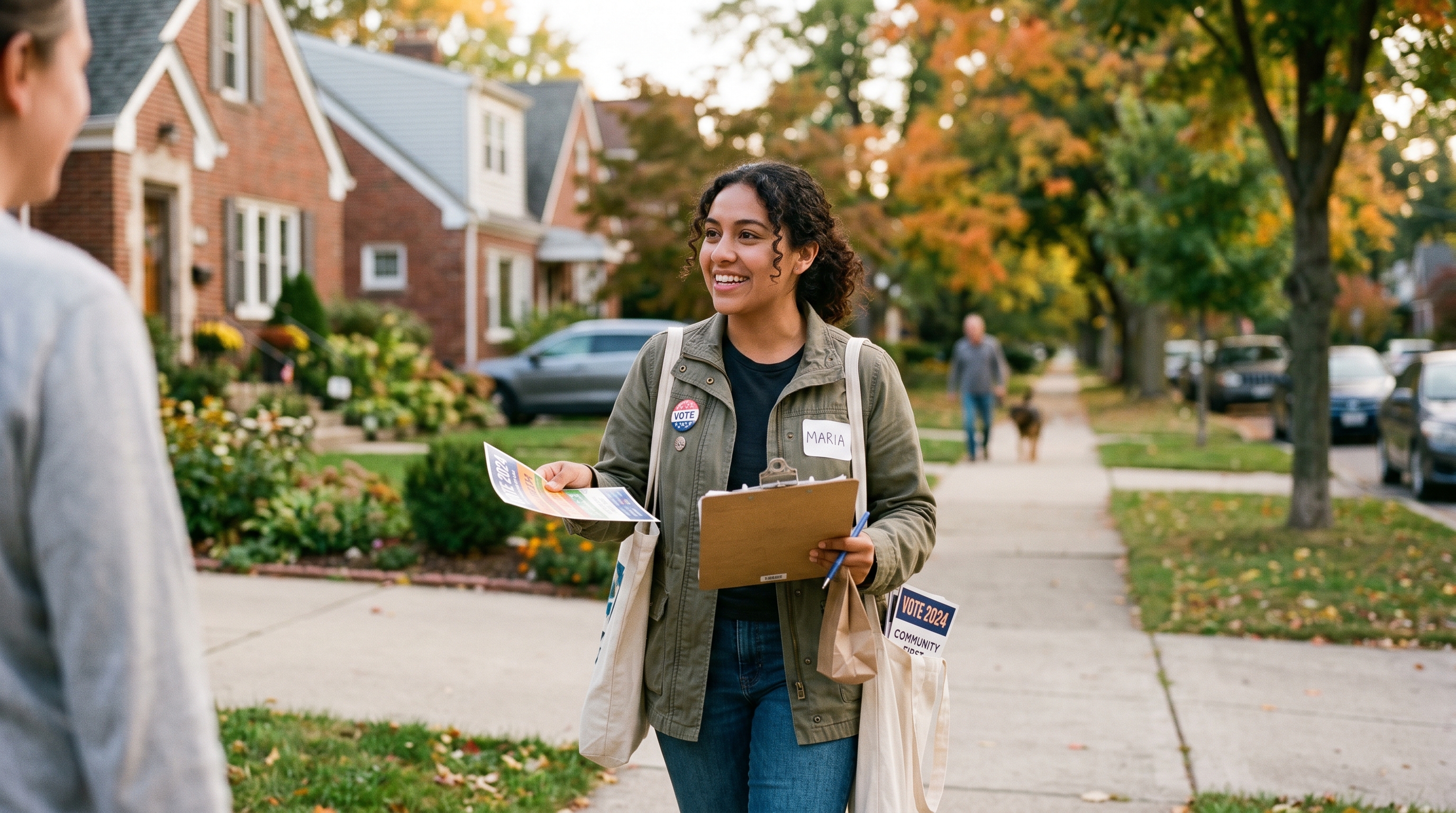
For campaigns managing volunteer tracking across multiple shifts and precincts, a volunteer tracking app gives you the real-time visibility you need to see who's active, who's lapsed, and where the sequence is breaking down. For the full picture of available platforms across the category, our volunteer management software roundup covers the major options with feature-by-feature comparisons.
Frequently Asked Questions
What is volunteer onboarding for political campaigns?
Volunteer onboarding is the structured process a campaign uses to move a new signup from interest to action — typically the first completed volunteer shift. It includes the welcome message, first-shift invitation, follow-up communications, and post-shift check-in that happen in the first 48–72 hours after someone signs up. Without a defined onboarding system, campaigns typically lose 30–50% of signups before a first shift.
How long should volunteer onboarding take?
The most effective campaigns close the signup-to-first-shift gap within 48 hours. Research on volunteer behavior consistently shows that enthusiasm peaks immediately after signup and decays sharply over the following days. Getting someone to commit to a specific shift within that window dramatically improves show rates and subsequent retention.
What should a volunteer welcome email include?
A strong volunteer welcome email should confirm the signup, name the campaign and candidate briefly, explain what volunteers actually do, name who they will be working alongside, set expectations for a first event, and close with one clear next action — ideally a direct link to schedule a first shift. Keep it under 200 words. More information does not improve conversion; a single clear action does.
What software supports campaign volunteer onboarding?
Look for platforms that combine volunteer sign-up forms, automated email sequences, shift scheduling, and volunteer analytics in a single system. Purpose-built campaign tools like Vox Populus automate the 48-hour onboarding sequence natively — triggering the welcome message, shift invite, and follow-up without manual intervention. General-purpose tools like MailChimp or Google Sheets can cover individual steps but require manual coordination across platforms, which breaks down under campaign pressure.
What is the most common volunteer onboarding mistake campaigns make?
The most common mistake is treating the signup confirmation email as the end of onboarding rather than the beginning. Sending a generic confirmation and then waiting for volunteers to take action on their own results in 30–50% dropout before the first shift. The second most common mistake is front-loading too much information — mission statements, policy positions, and organizational history — before asking for a single concrete action.
The System Is the Strategy
Every competitive race is decided on the margin. The campaign that converts more signups into first shifts, and more first shifts into repeat volunteers, has a structural advantage that compounds over the entire campaign cycle.
The playbook above is not complicated. Five touchpoints, a 48-hour window, and an automated system that handles the sequencing so your organizers can focus on field work. The campaigns that win field operations aren't the ones with the most volunteers on their list — they're the ones with the highest activation rate.
If you're running a city council, county, or state legislative race and want to see what a purpose-built onboarding system looks like in practice, explore what Vox Populus can do for your campaign.
References
- Clary, E. G., & Snyder, M. (1999). The motivations to volunteer: Theoretical and practical considerations. Current Directions in Psychological Science, 8(5), 156–159. Volunteer motivation research consistently identifies the importance of early activation in sustaining long-term commitment. ↩
- Corporation for National and Community Service, Office of Research and Policy Development. (2007). Volunteering in America: 2007 National, State, and City Information. Washington, DC. Findings indicate that volunteers who are engaged in a structured activity within the first week of sign-up demonstrate significantly higher retention at 30 and 90 days. ↩
- Gerber, A. S., & Green, D. P. (2012). Field Experiments: Design, Analysis, and Interpretation. W. W. Norton & Company. Application of field experiment methodology to volunteer contact and follow-up timing in campaign contexts shows material improvements in second-action rates when post-event acknowledgment occurs within the same day. ↩