
Last updated May 2026
Political SMS marketing programs consistently outperform every other outreach channel campaigns rely on. Text messages see open rates above 95% within three minutes of delivery — compared to 20–25% for email — and response rates 6–8× higher than email campaigns.[1] For campaign operators who need to move volunteers, activate supporters, and drive GOTV turnout, text is not a supplement to your program. It is the activation layer.
This guide covers everything you need to build a political SMS program that actually works: compliance requirements that will make or break your program before it launches, the strategic framework for list building and segmentation, effective message formats across every campaign use case, the tools serious campaigns are using in 2026, and the GOTV-specific tactics that produce measurable turnout impact on Election Day.
What Political SMS Marketing Is — and Why It Works
Political SMS marketing programs use text messaging to reach supporters, volunteers, and voters with campaign communications — shift reminders, fundraising asks, event invitations, GOTV mobilization, and relational outreach. Unlike email, which gets buried, and phone banking, which requires real-time availability from both parties, text meets people where they already are.
The data on SMS engagement is not subtle. SMS open rates exceed 95%.[1] The average text is read within three minutes of receipt. Response rates for peer-to-peer texting in political campaigns average 12–20% — email campaigns achieving 3–5% response are considered high performers.[2] For time-sensitive campaign actions — "shift starts in two hours," "polls close at 8pm," "we need 10 more signatures today" — nothing else comes close.
What makes political SMS different from commercial SMS marketing is the relationship context. You are not selling a product. You are asking people who have already raised their hand — signed up to volunteer, donated, or attended an event — to take the next step. That warm audience context is why political texting response rates run significantly higher than commercial benchmarks. The list is warm, the ask is specific, and the stakes are real.
Compliance and Legal Requirements
Compliance is where political SMS programs fail. Getting this layer wrong does not just produce low deliverability — it exposes your campaign to federal litigation. The rules are specific and campaigns frequently misread the exemptions that apply to them.
TCPA Requirements
The Telephone Consumer Protection Act (TCPA) regulates any text message sent via an automatic telephone dialing system (ATDS) to a mobile phone.[3] The core requirement for political campaigns using broadcast SMS platforms: prior express written consent before sending. The political exemption from the National Do Not Call Registry does not eliminate this consent requirement for autodialed texts.
What TCPA requires for A2P (application-to-person) broadcast SMS:
- Clear and conspicuous disclosure that the person is consenting to receive automated text messages
- Affirmative action by the individual (checking a box, texting a keyword, signing a form)
- Documentation of that consent in your database
TCPA violations carry statutory damages of $500–$1,500 per message. A 50,000-message send to contacts without documented consent is not a minor compliance gap — it is a material legal risk.
10DLC Registration
10DLC (10-digit long code) is the carrier-mandated registration framework for bulk SMS sent through standard 10-digit phone numbers.[4] Major carriers — AT&T, Verizon, T-Mobile — actively filter and block messages from unregistered senders. Campaigns that skip 10DLC registration do not get lower deliverability. They get no deliverability.
How 10DLC registration works:
- Register your organization (brand) with The Campaign Registry (TCR)
- Register your specific messaging use case (political campaign, volunteer outreach, fundraising)
- Attach your registered numbers to your approved campaign
- Maintain message volume and content consistent with your registration
Political campaign use cases are a recognized registration category. Registration typically takes 5–10 business days. Short codes (5–6 digit numbers) are an alternative that bypasses 10DLC but costs $500–$1,000/month to lease and requires separate carrier approval.
Opt-In Requirements and Opt-Out Handling
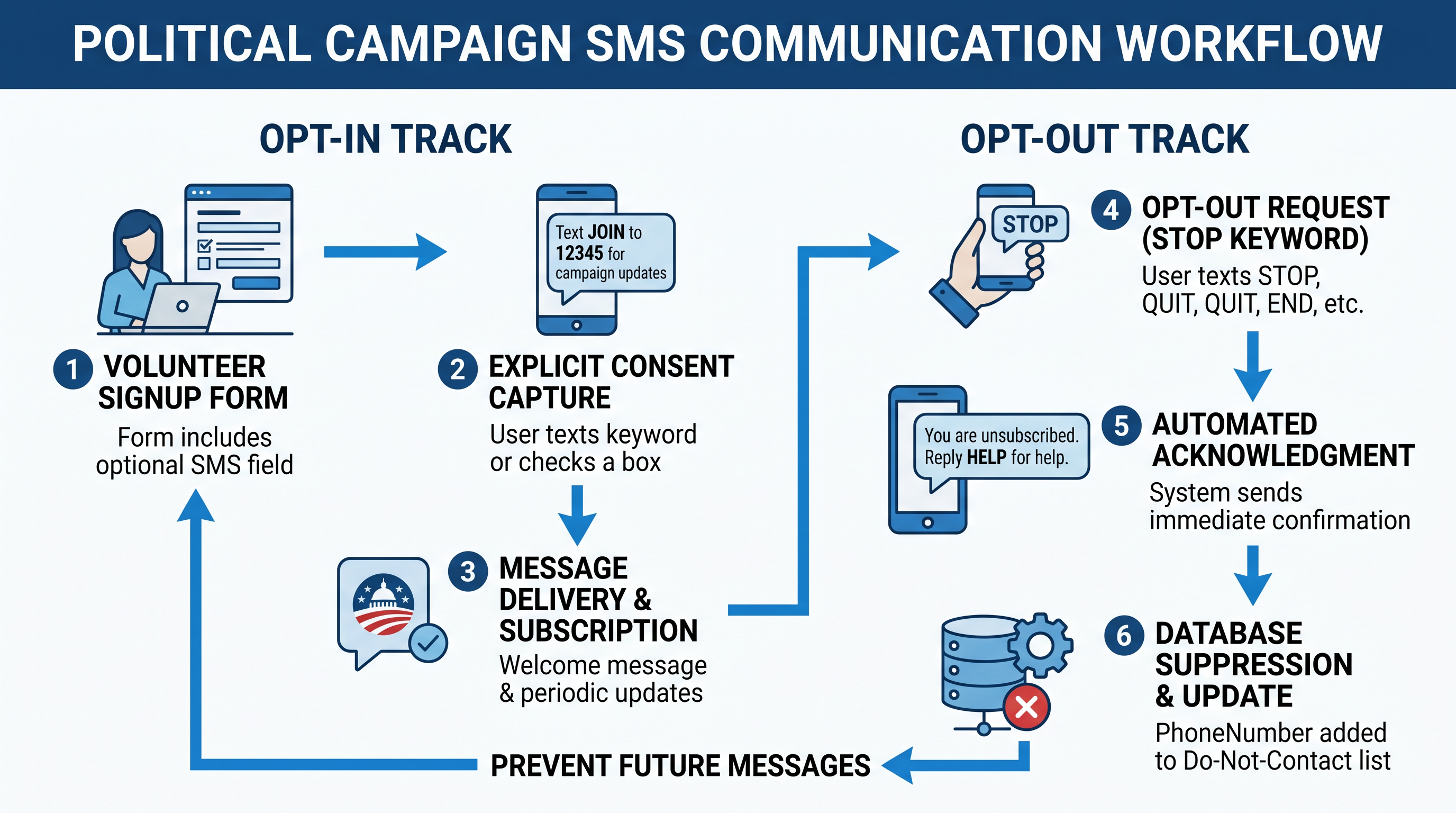
Every compliant political SMS program requires a documented opt-in process. The most defensible method: a web form with a checkbox explicitly stating "I agree to receive text messages from [Campaign Name]" or an inbound keyword (e.g., text JOIN to 55500) that creates a confirmed opt-in record.
Opt-outs must be honored immediately and permanently. The standard keyword is STOP. Every automated text message must include an opt-out instruction — typically "Reply STOP to unsubscribe" — in at least the initial message and periodically thereafter. Additional recognized opt-out keywords include UNSUBSCRIBE, CANCEL, END, and QUIT. Your platform should automatically suppress opted-out contacts from all future sends and log the opt-out with a timestamp.
Peer-to-Peer vs. Broadcast: Why It Matters for Compliance
The TCPA's ATDS definition was litigated in Facebook, Inc. v. Duguid (2021), which narrowed it to systems that use a random or sequential number generator.[3] True P2P texting platforms — where each message is manually triggered by a human volunteer — generally fall outside this definition. This is why P2P texting remains a primary tool for campaigns that want to reach contacts without documented opt-in consent.
Broadcast SMS sent through automated platforms does not benefit from this distinction. Know your platform type and build your compliance program accordingly.
Types of Political SMS Campaigns
Not all political texts are the same. Effective programs run multiple message types calibrated to different moments in the campaign lifecycle.
GOTV Texts The highest-stakes use of your SMS program. GOTV messages in the 48–72 hours before Election Day remind confirmed supporters to vote, provide polling location information, and create urgency through social proof ("Your neighbors are voting tomorrow"). Personalization at this stage — first name, local precinct, specific polling location — increases turnout impact measurably.[2]
Volunteer Shift Reminders This is where SMS delivers ROI that email cannot. A shift reminder sent two hours before a canvassing block or phone bank session reduces no-shows by 25–40% compared to email-only confirmation.[2] These messages are operational, not persuasive — they are the logistics layer that keeps your volunteer base showing up.
Event Announcements Town halls, visibility events, training sessions, and watch parties all benefit from SMS promotion. The key difference from email: keep the event SMS to one action and one link. Long-form event descriptions belong in email. The text is the trigger.
Fundraising Asks Political fundraising via text works best when the ask is specific, urgent, and tied to a real deadline — end-of-quarter, a matching opportunity, or a reported opponent fundraising number. Texts with a single link to a donation page convert at 2–3× the rate of generic "please donate" email blasts.[1]
Relational Organizing via P2P Peer-to-peer texting with real volunteer conversation scales the relational organizing model. Volunteers text through a queue loaded with identified supporters; each conversation is personal, responsive, and creates a direct connection between the campaign and the voter. P2P is resource-intensive — it takes volunteer time — but produces the highest response rates of any text channel, often 15–25% in active campaigns.
Strategy: Building a Political SMS Program That Scales
A political SMS program without a strategic foundation produces one-off results. The campaigns that get compounding returns from text build the program as a system — list, segmentation, cadence, and measurement.
List Building
Start with the contacts you already have — volunteer signups, donor files, event attendees. For each, document the opt-in source and date. Add SMS capture to every inbound touchpoint: volunteer signup forms, donation pages, event RSVPs, and website contact forms. A checkbox with explicit consent language is your legal foundation and your list growth engine.
Do not buy lists. Beyond the legal risk, purchased contact lists produce low engagement and high opt-out rates that will damage your sender reputation with carriers.
Segmentation
Sending the same message to your entire list is the fastest way to burn through goodwill and increase opt-outs. The minimum segmentation structure for a political SMS program:
- Volunteers — receive shift reminders, training announcements, activation asks, peer-to-peer outreach from other volunteers
- Donors — receive fundraising asks, impact updates, urgency-driven contribution appeals
- General supporters — receive GOTV messages, event invitations, campaign news
- High-engagement contacts — a subset within any category who have responded or taken action; these receive higher-frequency messaging and P2P outreach
Segment by geography when your campaign spans multiple precincts. A volunteer in one district does not need event announcements for a town hall three precincts away.
Message Cadence and Timing
TCPA restricts automated texts to 8am–9pm local recipient time. Within that window, campaign benchmarks show highest response rates on weekday evenings (6pm–8pm) and Saturday mornings (9am–11am). Avoid Monday mornings and Sunday evenings.
For volume: most campaigns run 2–4 messages per month to their general supporter list, and 1–2 messages per week to active volunteers. Frequency increases in the final three weeks before Election Day. Regardless of cadence, every message must have a single, clear action — do not combine a fundraising ask with a GOTV reminder in the same text.
Personalization
First name personalization is baseline and should be universal. Beyond that, location-specific data — polling place address, precinct-level volunteer stats, local event details — produces meaningfully higher response rates than generic campaign messaging. Your SMS platform should support merge fields for at minimum: first name, city/precinct, and next shift time.
Examples of Effective Political Texts
GOTV Message
Hi [First Name], it's [Campaign Name]. Election Day is TOMORROW. Your polling place is [Location] — open until 8pm. Can we count on you? Reply YES if you're voting. Reply STOP to opt out.
Volunteer Shift Reminder
[First Name] — reminder: your canvassing shift with [Campaign Name] starts at 2pm today at [Location]. Reply HELP for details or STOP to unsubscribe.
Event Invitation
Hey [First Name], [Candidate Name] is hosting a town hall this Thursday at [Venue] — doors at 6:30pm. Save your seat: [Link]. Reply STOP to opt out.
Fundraising Ask with Deadline
[First Name], our FEC deadline is midnight Friday. We're $3,200 short of our goal. $25 right now closes the gap: [Link]. – [Campaign Name]. Reply STOP to unsubscribe.
What these have in common: a single action, a specific detail that makes the message feel real (not templated), a clear opt-out path, and no message exceeding two short paragraphs. The tone is direct without being aggressive — consistent with the campaign operations voice that resonates with supporters who already believe in the work.
Tools for Political SMS Campaigns
The political SMS landscape has fragmented into broadcast platforms for automation and P2P platforms for relational organizing. Most campaigns use both.
CallHub A full-stack political communications platform combining broadcast SMS, P2P texting, and phone banking in one system. Strong integration with common political CRMs including NGP VAN and NationBuilder. 10DLC managed through the platform. Good choice for campaigns that want a single vendor for voice and text.
Hustle The dominant P2P texting platform in progressive politics. Volunteers load conversation queues and send individually, creating genuine one-to-one exchanges at scale. Strong opt-out handling and conversation logging. Pricing by conversation volume. Best for relational organizing programs with an active volunteer base.
ThruText Similar to Hustle — P2P platform built for political campaigns and advocacy organizations. Known for fast onboarding and reliable deliverability. Some campaigns run both ThruText and Hustle for specific program types.
Impactive A newer entrant that combines P2P texting with digital organizing features including social sharing, relational organizing, and volunteer management light. Useful for campaigns that want text integrated with broader digital outreach rather than as a standalone channel.
EZ Texting A broadcast SMS platform primarily used in commercial contexts but available to political campaigns. Lower barrier to entry and lower pricing at small volume, but fewer political-specific features. Suitable for small campaigns that need simple broadcast without the complexity of full political platforms.
Vox Populus (Coming Soon) The gap in the current political SMS stack is integration with the volunteer management layer. Every platform above is a standalone texting tool — shift reminders have to be built manually, volunteer opt-ins are managed in a separate database, and there is no connection between who shows up on a shift and what texts they received.
Vox Populus is building SMS as a native feature of the volunteer command center — not a separate tool. When text goes live, shift reminders will trigger automatically from the scheduling layer, activation texts will draw from volunteer analytics, and GOTV coordination will operate from the same platform already running signups, leaderboards, and field analytics. That integration is what the current standalone tools cannot replicate.
If you're using or evaluating Vox Populus today for volunteer management, SMS will land as part of the same platform — no new vendor, no new opt-in database, no manual data export.
How SMS Fits Into Your Broader Campaign Infrastructure
Text messaging does not operate in isolation. The campaigns extracting the highest ROI from SMS are the ones where text is one layer in an integrated political campaign management stack — connected to the CRM, the volunteer database, and the field operations layer.
For the volunteer dimension specifically, this is where most campaigns underperform. A text message that reminds a volunteer about a shift is only as effective as the volunteer tracking system behind it. If you do not know who is active, who is lapsing, and who showed up last week, your shift reminders go to the wrong people at the wrong frequency.
Field ops software and SMS should operate from shared data — not separate silos. When a field organizer assigns a turf walk, the shift confirmation text should go out automatically. When a volunteer no-shows, the follow-up text should pull from their engagement history, not a generic template. That integration is what separates a tactic from a program.
For a deeper look at how text fits the volunteer command channel specifically — how to use SMS to activate, retain, and coordinate volunteers rather than just broadcast to them — read the companion piece: Text Message Campaigns as a Volunteer Command Channel.
The choice of your underlying platform matters here too. A campaign CRM that does not support SMS integration forces you into manual data exports and two-system management. Purpose-built campaign management tools that treat text as part of the core architecture — not a bolt-on — are what serious campaigns are moving toward.
FAQs: Political SMS Marketing
Do political campaigns need to comply with TCPA?
Yes — and the exemptions are narrower than most campaign managers assume. Political campaigns are exempt from the National Do Not Call Registry, but they are still required to obtain prior express written consent before sending autodialed or pre-recorded text messages to cell phones under the TCPA. Peer-to-peer texting sent manually by volunteers falls outside the TCPA autodialer definition, but bulk broadcast SMS using an automated platform requires documented opt-in consent.
What is 10DLC and do campaigns need it?
10DLC (10-digit long code) is a carrier-approved messaging framework that requires organizations sending bulk SMS to register their brand and campaign use case with The Campaign Registry (TCR). Without 10DLC registration, messages sent through standard 10-digit numbers face heavy filtering and blocking by major carriers. Political campaigns using A2P broadcast texting must complete 10DLC registration or use short codes as an alternative.
What is the difference between peer-to-peer texting and broadcast SMS for campaigns?
Broadcast SMS is automated bulk messaging sent from a platform to a list — fast, scalable, but regulated under TCPA and requiring opt-in consent. Peer-to-peer texting uses volunteers to send texts individually through a tool that loads a queue — each message is manually triggered by a human, which keeps it outside the TCPA autodialer definition. P2P produces higher response rates but requires more volunteer hours. Most campaigns run both.
How much does a political SMS program cost?
Costs vary by platform and volume. Broadcast SMS typically costs $0.01–$0.05 per message. P2P platforms charge per send or per conversation, usually $0.03–$0.15 per text. Short code leasing adds $500–$1,000/month. A mid-size campaign running 50,000 texts per month through broadcast plus P2P tools can expect to spend $2,000–$8,000/month depending on volume and platform tier.
What opt-out handling is required for political text messages?
Any automated political text program must honor opt-out requests immediately. STOP is the standard keyword — if a recipient replies STOP, your platform must remove them from all future messages. Additional recognized keywords include UNSUBSCRIBE, CANCEL, END, and QUIT. Failure to honor opt-outs exposes campaigns to TCPA liability. P2P platforms handle opt-outs differently, but best practice is to log all opt-out requests in your contact database regardless of channel.
When is the best time to send political text messages?
TCPA restricts automated messages to 8am–9pm local recipient time. Within that window, response rates are highest on weekday evenings (6pm–8pm) and Saturday mornings (9am–11am). GOTV texts in the 48 hours before Election Day see significantly higher engagement regardless of timing. Keep volume reasonable — multiple texts per day produces opt-outs, not turnout.
The Bottom Line
Political SMS marketing programs are not complicated in concept. The operational discipline required to run one correctly — documented consent, 10DLC registration, proper segmentation, a clear message cadence, and accurate opt-out handling — is where most campaigns fail.
Build the compliance layer first. It is not optional and it is not separable from the strategy. Then build the list properly, with documented opt-ins from your warmest contacts. Then build the messaging system — broadcast for reach, P2P for relationships, GOTV texts for the final push.
The campaigns winning on text are the ones treating SMS as infrastructure, not a last-minute broadcast. That means integrating text with your volunteer management software, your scheduling system, and your field ops data — not running it as a standalone channel on a separate platform.
Vox Populus is building toward that integration. The platform already handles volunteer signups, shift scheduling, email campaigns, analytics, and gamified leaderboards. SMS is next — and when it arrives, it will work from the same volunteer database your field team is already using, not a separate system that requires manual synchronization.
Related Reading
- Text Message Campaigns as a Volunteer Command Channel
- Volunteer Management Software for Modern Political Campaigns
- Field Ops Software: How Distributed Campaigns Coordinate Turf, Shifts, and Reporting
- Campaign CRM vs. Generic CRM
- Volunteer Tracking App: Turn Volunteer Chaos Into a Measurable GOTV Advantage
References
- SimpleTexting, "SMS Marketing Statistics" (2025). Industry benchmark data on SMS open rates and response rates versus email. ↩ ↩2 ↩3
- Analyst Institute, "Texting for GOTV: Evidence Review" (2024). Peer-reviewed analysis of text message effectiveness in voter mobilization programs. ↩ ↩2 ↩3
- Federal Communications Commission, "Telephone Consumer Protection Act (TCPA)" — FCC enforcement guidance and Facebook, Inc. v. Duguid, 592 U.S. 395 (2021). https://www.fcc.gov/consumers/guides/stopping-unwanted-robocalls-and-texts ↩ ↩2
- CTIA, "10DLC — Application-to-Person (A2P) Messaging" — Carrier guidance on 10-digit long code registration requirements. https://www.ctia.org/the-wireless-industry/industry-commitments/texting-best-practices ↩