
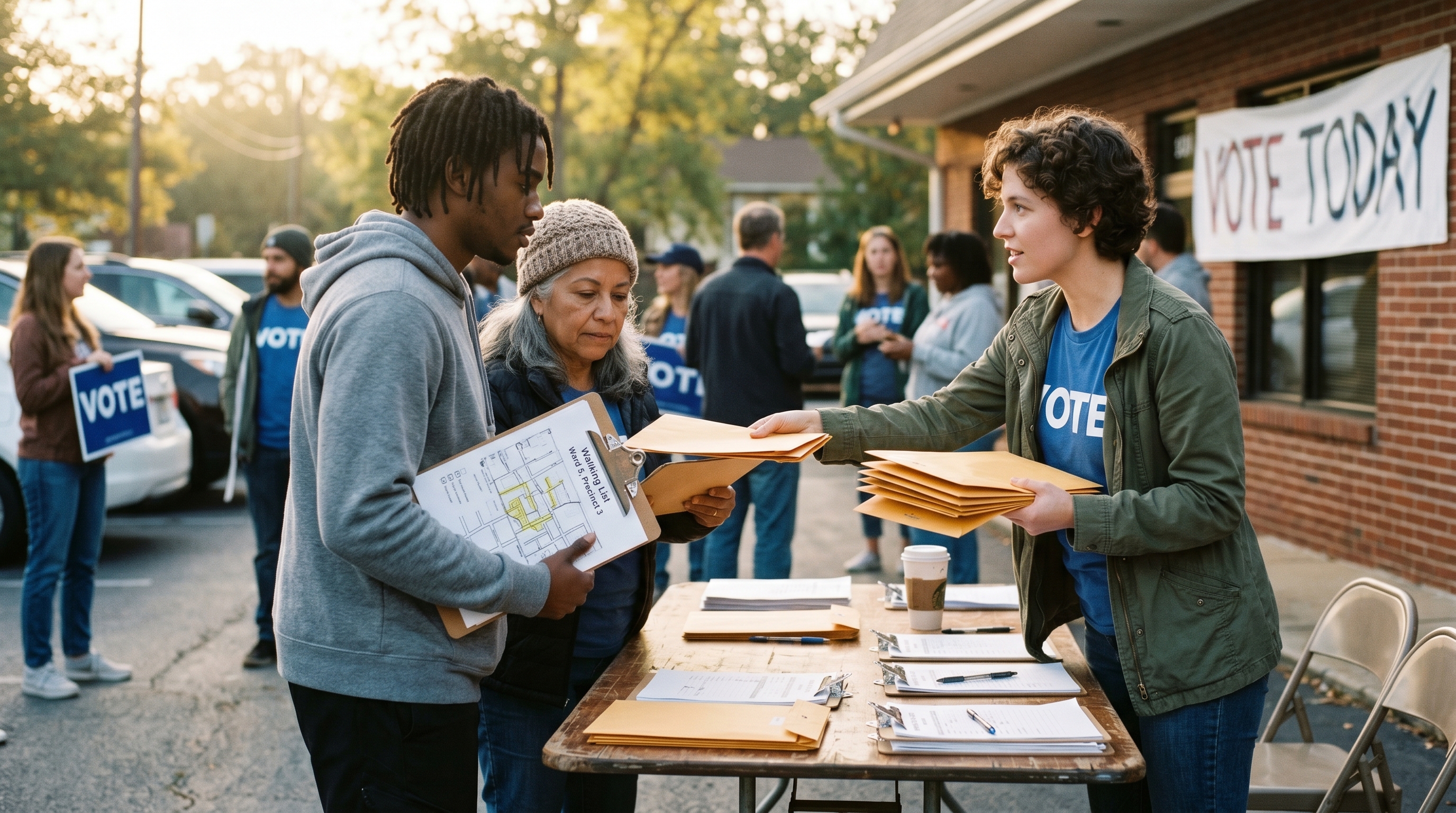
Last updated May 2026
GOTV volunteer coordination is the operational layer that determines whether your voter contact universe actually gets contacted in the 72 hours before polls close — or whether you run a beautiful campaign and lose by 400 votes because three precincts went dark.
The campaigns that win do not just "get out the vote." They build a ground game infrastructure months before Election Day: tiered volunteer lists, shift grids, turf assignments, a communications sequence, and a data loop that shows them in real time whether the plan is executing. By the time GOTV weekend arrives, the work is already done. Election Day is the deployment.
This is the field manual for that infrastructure.
What GOTV Volunteer Coordination Actually Means
"Get out the vote" is often treated as a single event — a push at the end of the campaign. It is not. It is a compressed operational sprint that draws on everything the campaign has built over the preceding months: the volunteer list, the voter contact data, the shift scheduling system, the communications infrastructure.
GOTV volunteer coordination is the operational layer that connects all of it. It means:
- Turf division — breaking the district into manageable walk and phone bank territories mapped to your target voter universe
- Shift scheduling — building a grid of volunteer shifts across the 3–5 days before Election Day and filling every slot
- Role assignment — matching volunteers to the specific roles the operation needs (canvassers, phone bankers, poll greeters, visibility volunteers, election day ward captains)
- Real-time redeployment — adjusting staffing mid-operation when no-shows happen and coverage gaps emerge
- Volunteer communications — the confirmation sequence, same-day reminders, and follow-up after the polls close
When it works, a GOTV ground game looks like this: every high-priority voter in every target precinct gets at least one personal contact in the final 72 hours. Shifts fill on time. Ward captains have their turf, their lists, and their volunteers accounted for. The campaign manager can see, in real time, which precincts are on pace and which need reinforcement.
When it does not work, it looks like this: a campaign office full of volunteers who do not know their turf, a shift board with gaping holes, no-shows with no backup plan, and a campaign manager calling volunteers from a spreadsheet at 6am on Election Day.
Research is consistent on the impact of a well-run ground game. Face-to-face canvassing by volunteers — not paid staff, not mail, not digital ads — is the highest-impact voter contact method, consistently producing 2–4 percentage point increases in turnout among targeted voters.[1] A 2018 analysis of 49 field experiments found that personal canvassing mobilized voters at roughly twice the rate of phone banking, and both significantly outperformed mail and digital.[2] In close city council and state legislative races — where margins of 200–600 votes are common — the math is straightforward. GOTV is where campaigns are decided.
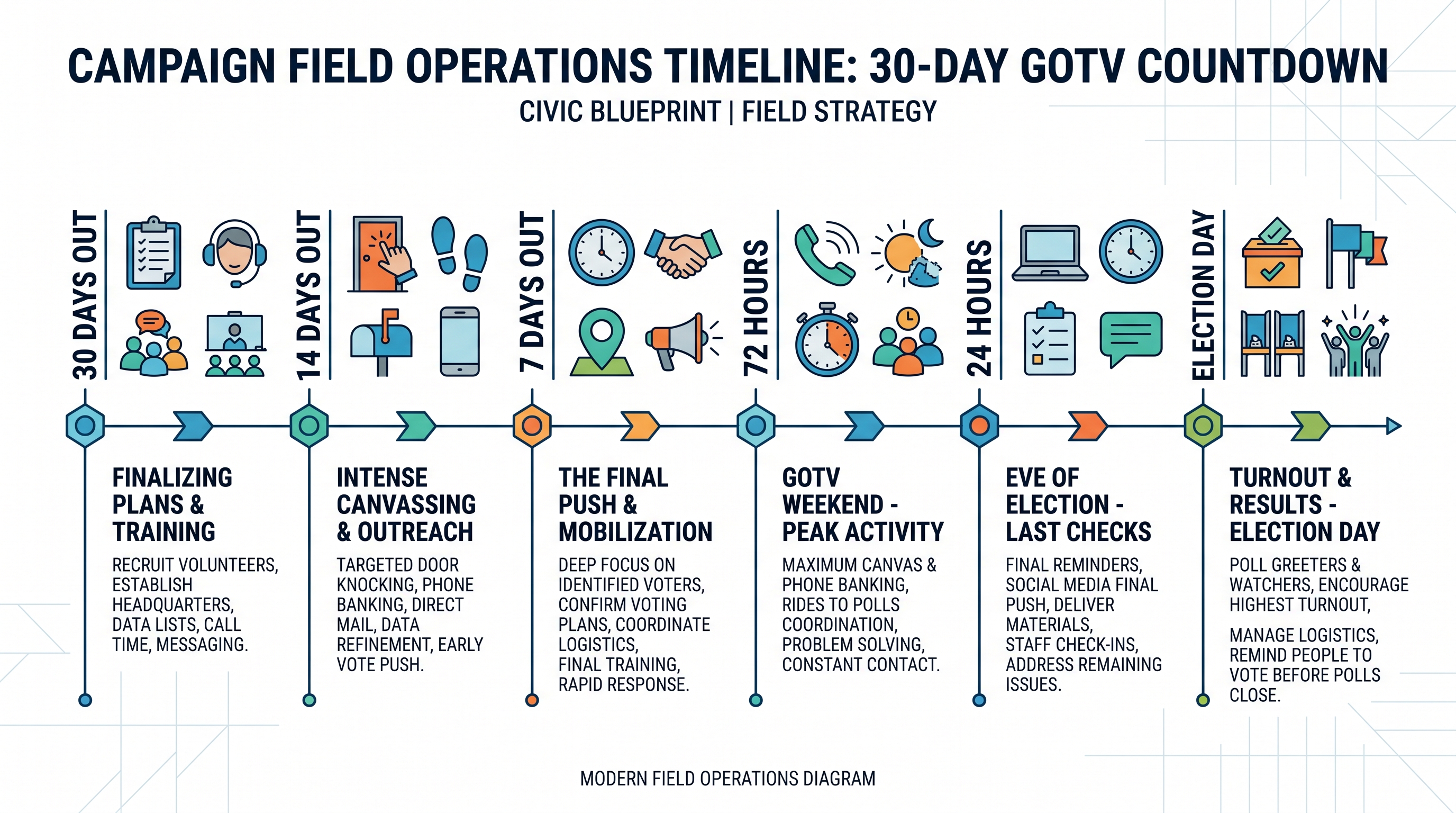
The GOTV Timeline
Work backwards from Election Day. The campaigns that scramble on GOTV weekend are the ones that treated the timeline as starting 72 hours out. Start 30 days out.
30 Days Out
- Finalize your target voter universe — the specific voters you are trying to mobilize, prioritized by turnout propensity and support score
- Complete turf division across all target precincts
- Assign precinct captains or ward leads for each priority area
- Begin filling the GOTV shift grid — at 30 days out, target 30% shift capacity committed
- Publish the volunteer sign-up portal and send a recruitment push to your full list
- Confirm that your volunteer scheduling and tracking systems are set up and tested
14 Days Out
- Shift grid should be 60–70% filled
- Confirm all precinct captains and walk leads; brief them on their turf and GOTV roles
- Run a training for GOTV-specific roles — especially canvassers unfamiliar with your turf or script
- Identify high-priority volunteers (your A-tier; see below) and confirm their specific shifts directly
- Send first GOTV recruitment email to any unscheduled volunteers on your list
7 Days Out
- Shift grid should be at or above 80% capacity
- Finalize printed walk lists and canvassing materials — have them ready before GOTV weekend
- Confirm all precinct captains are equipped with their turf maps, contact lists, and check-in protocols
- Identify coverage gaps and activate outreach to fill them (targeted appeals to reliable volunteers)
- Confirm data access for real-time tracking during GOTV
72 Hours Out
- Send the full confirmation sequence to all scheduled volunteers (see Communications section)
- Run a final shift capacity audit — flag any shifts under 70% fill rate and activate backup recruitment
- Brief all ward captains on election day protocol: check-in time, reporting structure, redeployment authority
- Confirm all canvassing and phone banking materials are printed and staged
24 Hours Out
- Send same-day reminder texts to all volunteers with shift times, locations, and reporting instructions
- Brief shift leads on no-show protocol: who to call, what the redeployment options are
- Confirm poll greeter and visibility assignments for Election Day morning
Election Day
- Operate from your command center — this is not the time to be in the field, it is the time to be watching the data
- Run hourly check-ins with precinct captains on doors knocked vs. target, volunteer attendance, and coverage gaps
- Execute real-time redeployment when precincts fall behind pace
- Close the loop: poll monitoring through the close, final push communications to any remaining targets in the last two hours
Volunteer Roles in a GOTV Operation
GOTV is not a single volunteer job. Campaigns need multiple roles filled simultaneously, and the right people in the right roles determine whether the operation runs smoothly or collapses into chaos.
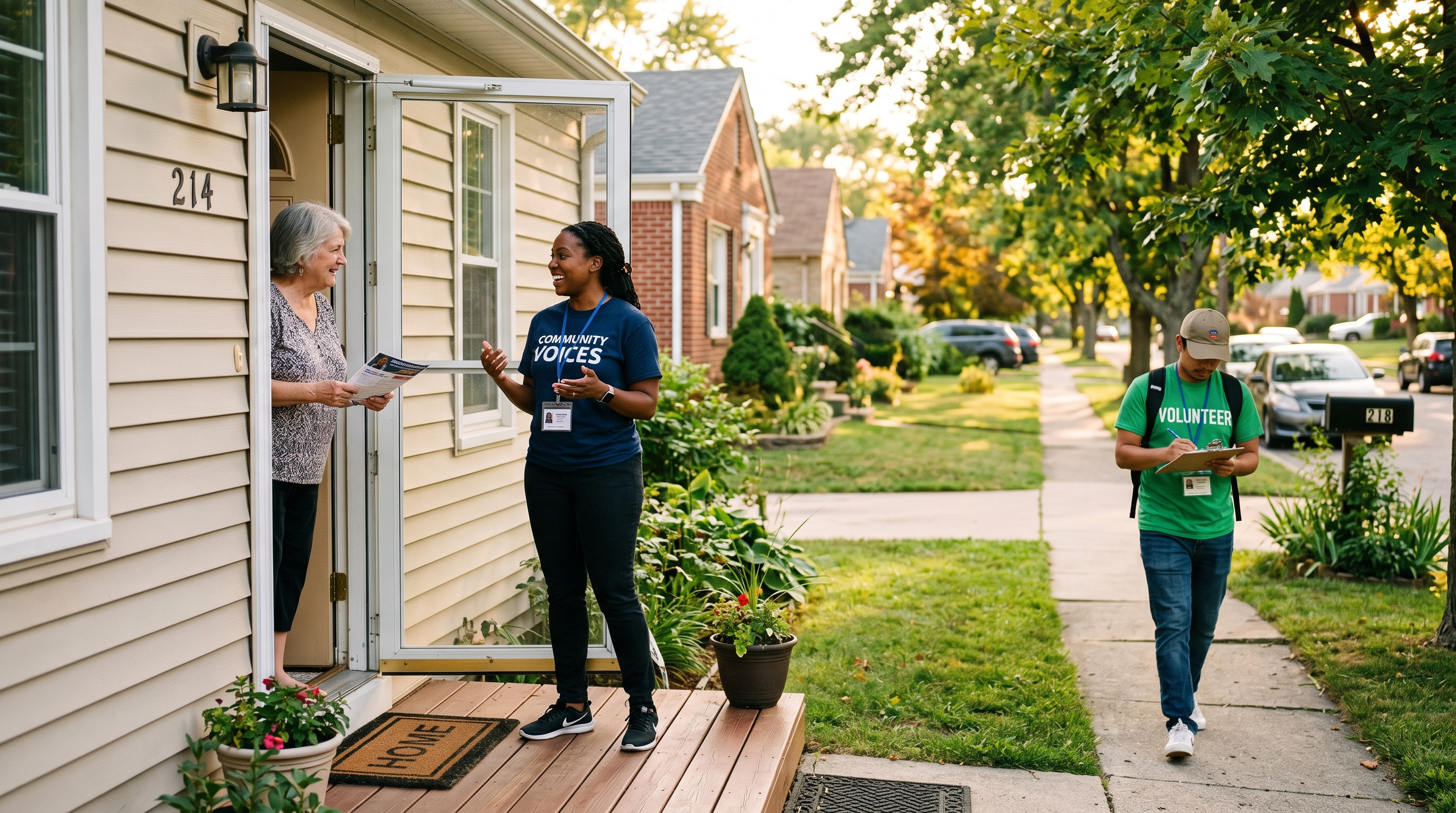
Canvassers are the core of the ground game. They walk assigned turf, knock doors, and deliver the GOTV message face-to-face to targeted voters. A canvasser team for a 3-hour shift should be assigned 25–35 doors depending on density and walk time. Pair new volunteers with experienced canvassers when possible. Personal canvassing by volunteers — not paid staff — consistently outperforms every other voter contact method.[1]
Phone bankers handle the high-propensity voters who are harder to reach at the door, plus backup contact for any voter who wasn't home during canvassing. Phone banking can be run from a central location or remotely. For remote phone banking, your volunteer tracking system needs to be able to confirm completions without relying on manual check-ins.
Poll greeters are stationed near polling locations on Election Day, providing last-mile encouragement to voters who are on your support list and have not yet cast a ballot. This requires careful attention to your jurisdiction's electioneering distance rules — typically 100 feet from the polling place entrance — and should only be staffed by volunteers who have been briefed on compliance.
Literature droppers cover the final push in the 24 hours before polls open, leaving door hangers and GOTV literature at the homes of targeted voters who have not yet been personally contacted. This is a high-volume, lower-skill role good for newer volunteers who aren't ready to script a door knock.
Visibility volunteers staff high-traffic intersections and public locations with campaign signs and wave cards in the final days. This is a lower-priority GOTV role but important for last-minute visibility in competitive areas.
Election Day ward captains are the most critical role in the operation. A ward captain is responsible for a defined precinct or cluster of precincts — they manage the check-in, assign turf to arriving canvassers, track completion, report to the campaign manager, and have redeployment authority for their area. This role requires your most reliable, experienced volunteers. Every precinct should have a named ward captain before GOTV weekend begins.
For a lean campaign, prioritize the roles in this order: ward captains first, canvassers second, phone bankers third. Visibility and literature drop are nice-to-have, not must-have.
Building the Volunteer List for GOTV
Your volunteer list for GOTV is not the same as your full volunteer list. It is a tiered subset of people you can actually count on.
Tier your volunteers into three groups:
A-tier (confirmed reliable): Volunteers who have completed at least two shifts earlier in the campaign, responded promptly to communications, and have been directly confirmed for GOTV. These are the people you can count on. A-tier volunteers get direct personal outreach from the campaign manager or a named staff member, not just an automated reminder.
B-tier (engaged but inconsistent): Volunteers who have signed up and shown up at least once, but have missed shifts or are less consistent. They are real capacity but require more hands-on management. Fill your shift grid with B-tier volunteers but build in the expectation that 30–40% will not show.
C-tier (signed up, never shown): Volunteers who are on your list but have never completed a shift. Treat these as low-probability capacity. Send them GOTV appeals, but do not build your shift projections around them.
The critical mistake most campaigns make: they look at their total volunteer sign-up number and plan accordingly. If you have 200 signed-up volunteers, your actual GOTV capacity is probably 90–120 people — and 30 of them will not show up when you need them. Plan for the number you can actually deploy, not the number on the spreadsheet.
A volunteer management platform with engagement analytics makes this tiering process tractable at scale. Without one, you are doing manual triage on a spreadsheet the night before Election Day.
For more on building a volunteer list that converts, see the volunteer onboarding guide.
Shift Management Under Pressure
No-shows are not an exception in GOTV operations — they are the baseline. The campaigns that handle GOTV weekend well have a no-show protocol built in before the first volunteer checks in.
Fill protocol by role:
For any shift that falls below 70% fill rate at 24 hours out, activate a targeted outreach sequence: first to your B-tier volunteers who are signed up but in a different slot (ask for a shift change), then to your A-tier volunteers who have not yet committed to that specific time, then to your general list with an urgent appeal. This is not a mass blast — it is personal outreach, preferably by phone or text from someone the volunteer knows.
Real-time redeployment on GOTV weekend:
When canvassers complete their turf ahead of schedule — or when a precinct falls behind because of no-shows — the ward captain's job is to redeploy available volunteers to where the coverage gap is. This requires three things: a live view of completion by precinct, a communication channel to ward captains in the field, and pre-positioned volunteers who can flex between assignments.
Without a real-time view of what is happening in the field, redeployment decisions are guesswork. This is the exact problem field ops software is built to solve — giving the campaign manager a live dashboard of shift fill rates, precinct completion, and volunteer location so redeployment calls can be made before it is too late to matter.
Election Day no-show protocol:
When a ward captain reports a no-show, the campaign's response should be immediate and follow a fixed sequence: (1) attempt contact with the no-show via text and phone, (2) check if the shift can be partially covered by extending an adjacent shift, (3) pull from the standby volunteer list — a short list of reliable volunteers who have been told they may be called the morning of Election Day for exactly this situation. Every GOTV operation should have 10–15 standby volunteers committed before Election Day begins.
Communications During GOTV
Communications during GOTV is not about inspiration — it is about execution. The right message, to the right volunteer, at the right time, through the right channel.
The confirmation sequence (72 hours out):
Send a confirmation email to every scheduled volunteer with: their specific shift time and location, the name and contact number of their shift lead or ward captain, exactly what they should bring and what to expect, and a clear confirmation link or reply request. Email confirmation response rates on GOTV weekend typically run 40–60% — which means 40–60% of your volunteers have not confirmed. That gap is your no-show risk.
Same-day reminders (24 hours and day-of):
Text is the highest-response channel for same-day outreach. Send a reminder text 24 hours before each shift with the location and reporting time. Send a second text 2 hours before the shift starts. Keep both short — volunteers do not read long texts. "Reminder: Your canvassing shift starts at 10am at [address]. Your ward captain is [name]. Reply with any questions." That is enough.
For a full look at how to build an SMS communications strategy for GOTV, see the political SMS marketing guide.
During the operation:
Keep a text thread or channel open with all ward captains during GOTV weekend for real-time updates and redeployment coordination. This is not the time for email — it is too slow. Ward captains should be able to reach the campaign command center immediately.
After the polls close:
The communication that most campaigns skip: thanking volunteers immediately after Election Day. Send a personal thank-you within 24 hours — ideally a text the night of, followed by a more detailed email the next day. Call your A-tier volunteers by name. Acknowledge the specific contribution. This is the foundation of your volunteer list for the next campaign or the next election cycle.
Research by Donald Green and Alan Gerber documents that personal, authentic appreciation from campaign leadership is a strong predictor of whether volunteers remain engaged in future cycles.[3] The post-election thank-you is not a courtesy — it is list maintenance.
Data and Measurement: Is the Ground Game Working?
By GOTV weekend, you should have a live view of four metrics:
1. Precinct completion rate — doors knocked vs. doors targeted, by precinct. This is the primary measure of whether the ground game is executing. A precinct below 50% completion at 4pm on the Saturday before Election Day needs immediate attention.
2. Shift fill rate — scheduled slots filled vs. slots planned, by time block. This tells you whether your volunteer capacity projections are holding. If fill rates are running below 75%, activate your standby list now, not later.
3. Volunteer activation rate — signed-up volunteers who actually deployed vs. total signed up. This number is always lower than campaigns expect. Track it in real time to give you the most accurate projections for remaining shifts.
4. Phone banking contact rate — successful voter contacts per hour of phone banking effort. If this number is low, check your lists — are they current? Are you hitting voicemail because your targets have already voted?
What you do with this data depends on your window. On Saturday, a precinct below pace has 24+ hours to recover — you can redeploy canvassers, run targeted phone banking, and close the gap. On Monday evening, a precinct below pace has one option: extend shifts and pull standby volunteers. The data only matters if you are watching it early enough to act.
For volunteer analytics and real-time shift tracking, Vox Populus surfaces these metrics in a live dashboard — shift fill rates, volunteer activation, and precinct completion in one view, updated as volunteers check in and report.
Common GOTV Mistakes
Deploying too late. The campaigns that run their first volunteer training the week before Election Day are not running GOTV — they are running triage. GOTV preparation begins 30 days out. If it does not, you do not have enough time to tier your volunteer list, fill your shift grid, or train your ward captains.
Underestimating no-shows. A 30–40% no-show rate on GOTV weekend is normal. It is not a failure of volunteer management; it is the baseline expectation for uncompensated political work during a high-stress weekend. The campaigns that handle it well build redundancy in. The ones that fail assume attendance equals commitment.
No backup plan for under-staffed precincts. If a precinct has no contingency when its canvassing team is short, it simply goes uncovered. Document the backup plan before Election Day: who are the standby volunteers, what are the redeployment options, and who has authority to activate them.
Not celebrating volunteers after the election. Whether you win or lose, the volunteers who showed up during GOTV ran the most demanding operation the campaign asked of them. Failure to acknowledge that, immediately and specifically, is the fastest way to lose the volunteer base you spent months building. It is also, frankly, ungrateful.
Tools That Support GOTV Coordination
A lean campaign does not need an enterprise tech stack. It needs the right tools at the right layers:
Volunteer management and scheduling is the foundation. You need one system that holds your full volunteer list, manages sign-ups and shift assignments, sends communications, and tracks attendance. Vox Populus is built for exactly this: volunteer sign-ups, shift scheduling, engagement analytics, gamified leaderboards that increase volunteer activation, and email campaigns — all in one place, at $100/month. For a first- or second-time campaign manager running a city council or state legislative race, this is the operational core.
Canvassing and turf management requires a purpose-built app — MiniVAN (NGP VAN), Ecanvasser, or similar — for assigning walk lists and capturing door-knock data in the field. This is the tool your canvassers carry on GOTV weekend.
SMS for GOTV activation is the highest-leverage communication channel for same-day outreach. If your volunteer management platform does not support text messaging, you are leaving your highest-response confirmation channel off the table. Vox Populus has SMS coming soon — until then, see the political SMS marketing guide for compliant texting options.
Data integration between your voter file (VAN, TargetSmart, or your state's voter data vendor) and your volunteer management system is where the most sophisticated campaigns operate. At minimum, your canvassing app should sync contact data back to the campaign so you can see in real time what percentage of your target universe has been touched.
For a broader look at the full campaign tech stack, see political campaign management tools and field ops software.
Frequently Asked Questions
How many volunteers do I actually need for a competitive GOTV operation?
Plan for a 30–40% no-show rate on GOTV weekend, so work backwards from your contact universe. For a typical city council race targeting 5,000 voters across 10 precincts, you need roughly 40–60 committed canvassers per day on the final weekend to cover the turf at 30 contacts per volunteer per 3-hour shift. Build your list to 2x the capacity you actually need, then tier your volunteers so you know which ones are reliable enough to count on.
When should GOTV volunteer coordination begin?
Meaningful GOTV coordination starts 30 days out, not the week before. At 30 days, you should be assigning turf, confirming volunteer roles, and locking in shift slots. By 14 days out, your shift grid should be 60% filled. If you are starting your GOTV coordination 72 hours before Election Day, you are already behind — you are executing a plan, not building one.
What is the biggest GOTV volunteer coordination mistake campaigns make?
Deploying too late and building no redundancy for no-shows. Most campaigns assume their volunteer list equals their actual capacity. It does not. Signed-up volunteers convert to actual field presence at roughly 50–65% on GOTV weekend. The campaigns that win treat every shift as under-staffed by default and have a fill protocol ready before they need it.
How should I communicate with volunteers during GOTV weekend?
Use a layered channel approach: email for confirmations sent 72 hours out, text for same-day reminders and real-time redeployment, and a phone tree for no-show outreach. During GOTV weekend, your ward captains and shift leads are the human layer on top of any software system. Text is the highest-response channel — if you do not have SMS capability, you are managing GOTV at a significant disadvantage.
What data should I be tracking in real time on Election Day?
Four metrics matter on Election Day: doors knocked vs. doors targeted (precinct completion rate), shift fill rate by precinct, volunteer activation rate (signed up vs. actually deployed), and phone banking contact rate. If a precinct is falling behind pace by mid-afternoon, you have a three-hour window to redeploy — but only if you are watching the numbers in real time. A post-election debrief on what the data showed is where the lessons live.
Can a small campaign with a limited budget run an effective GOTV ground game?
Yes, but only with tight prioritization. A lean campaign wins by concentrating volunteer capacity in the highest-impact precincts — the ones where your voters are soft supporters or low-propensity turnout — rather than spreading thin across the entire district. The most effective small-campaign GOTV operations run 2–3 core roles (canvassers, phone bankers, one ward captain per high-priority precinct) and cover communication gaps with SMS rather than additional headcount.
The Bottom Line
GOTV is not a sprint — it is the final mile of a marathon. The campaigns that execute it well are the ones that built the infrastructure before the final 72 hours: the tiered volunteer list, the filled shift grid, the briefed ward captains, the live data dashboard. Election Day is the deployment, not the planning session.
If your campaign is running a city council, county, or state legislative race and you are managing volunteer coordination from spreadsheets, the ground game you plan and the one you actually run will look very different when Saturday morning arrives. The gap between them — unfilled shifts, no-show chaos, precincts going dark — is what the right volunteer management software is built to close.
The playbook is here. The infrastructure that makes it executable is at Vox Populus.
References
- Green, D.P. & Gerber, A.S. (2019). Get Out the Vote: How to Increase Voter Turnout (4th ed.). Brookings Institution Press. Face-to-face canvassing by volunteers is the highest-impact voter contact method, consistently producing 2–4 percentage point increases in turnout. ↩ ↩2
- Broockman, D. & Kalla, J. (2018). "The Minimal Persuasive Effects of Campaign Contact in General Elections: Evidence from 49 Field Experiments." American Political Science Review, 112(1), 148–166. Analysis found personal canvassing mobilized voters at roughly twice the rate of phone banking. ↩
- Gerber, A.S., Green, D.P., & Larimer, C.W. (2008). "Social Pressure and Voter Turnout: Evidence from a Large-Scale Field Experiment." American Political Science Review, 102(1), 33–48. Personal acknowledgment and social recognition are strong predictors of continued volunteer engagement. ↩