

Last updated May 2026
If you have been using Bloomerang for campaign volunteer management — or have been recommended it by someone in the nonprofit world — you have probably run into the same friction. Bloomerang is excellent software. It is just not built for campaigns.
The best Bloomerang alternatives for political campaigns are Vox Populus (purpose-built for campaign volunteer ops), Mobilize (volunteer events and coordination at scale), and VolunteerHub (strong nonprofit-to-campaign crossover with shift management). Each trades Bloomerang's donor management depth for the campaign-specific workflows that actually move volunteers from signup to action.
This guide covers what Bloomerang is built for, where it creates friction for campaigns, and seven alternatives worth evaluating — with honest assessments of who each one is right for.
What Bloomerang Is Built For
Bloomerang is a nonprofit donor management and volunteer management platform. It does both well — for nonprofits.
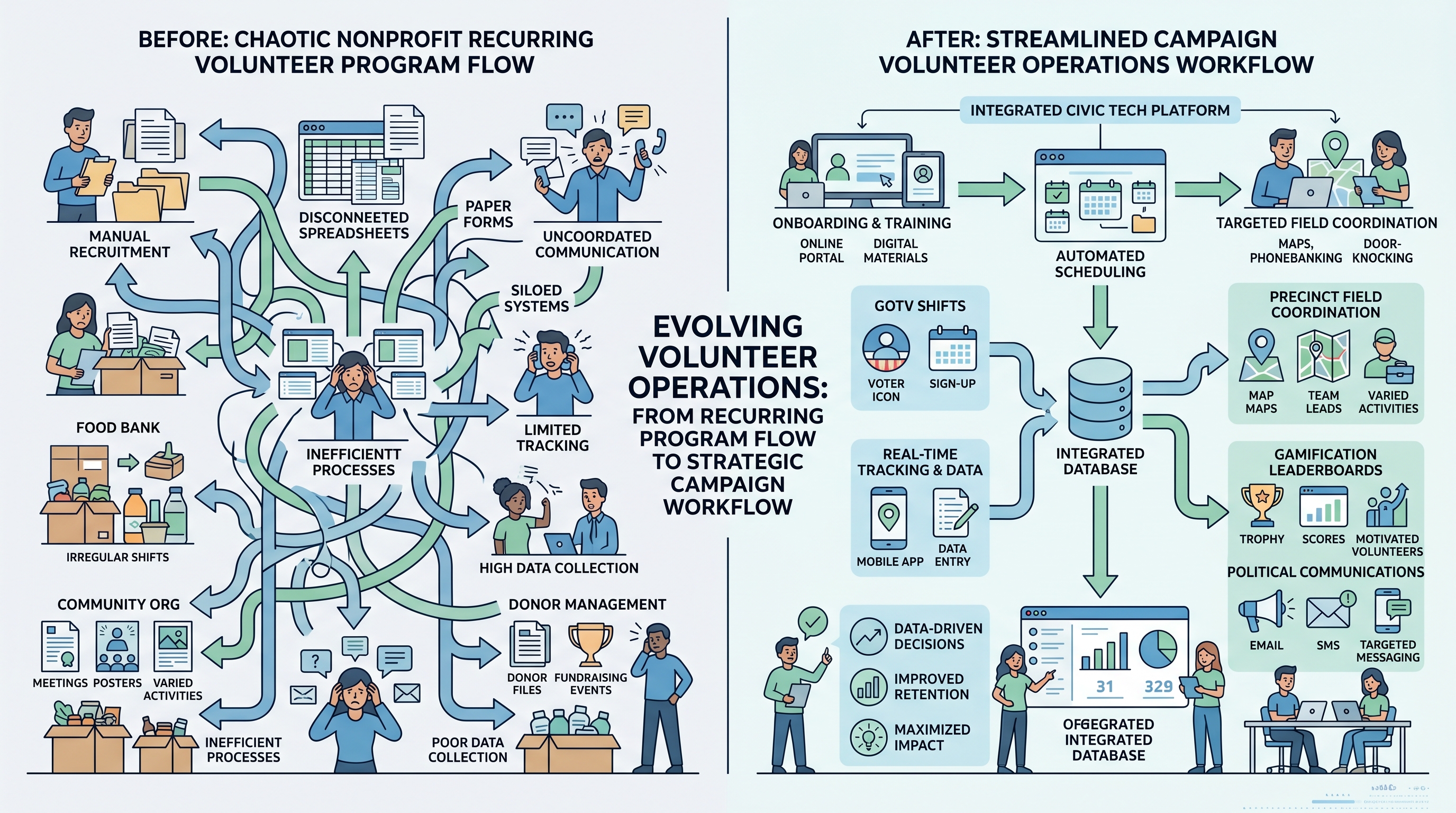
On the donor side, its retention dashboards, giving history, and constituent engagement scoring are genuinely strong. Nonprofits track donor relationships across years; Bloomerang is built for that time horizon. On the volunteer side, it handles recurring programs — the food bank volunteer who shows up every Saturday, the hospital auxiliary that rotates a regular roster — with clean scheduling and hour logging tools.
If you are running a food bank, a community foundation, or a social services nonprofit, Bloomerang is a reasonable choice. The friction is specific: it is not built for campaigns.
Why Bloomerang Creates Friction for Political Campaigns
Campaign volunteer management is a structurally different problem from nonprofit volunteer management. Here is where the gap shows up:
GOTV shift management. Campaigns run compressed, high-urgency volunteer windows — phone bank nights, canvass days, visibility shifts, election day ward captains. Bloomerang's scheduling is built for recurring, stable nonprofit roles. Mapping it to a campaign GOTV calendar requires significant manual workarounds.[1]
Precinct-level field coordination. You need to know which volunteers covered which turf, what precincts are under-resourced, and where to redeploy people before Election Day. Bloomerang has no concept of turf or geographic precinct assignment.
Volunteer gamification and leaderboards. High-functioning campaign volunteer programs use gamification to drive participation — points, leaderboards, friendly competition between volunteers. There is no native gamification layer in Bloomerang.
Political communications cadence. Campaign outreach follows a different rhythm than nonprofit outreach — pre-launch recruitment, canvass confirmation, GOTV urgency sequences, post-shift thanks. Bloomerang's communications tools are built around donor retention, not campaign mobilization.
No political CRM layer. There is no native integration with political infrastructure — VAN, voter file data, canvassing apps. For campaigns that need volunteer activity tied to voter contact data, Bloomerang is a dead end without significant custom integration.
None of this is a knock on Bloomerang — it is the right tool for what it is built for. But if your operation is a city council race, a state legislative campaign, or a county-level ballot initiative, you are operating in a context Bloomerang was not designed for.
For more on what modern campaign volunteer management requires, see Volunteer Management Software for Modern Political Campaigns.
7 Bloomerang Alternatives for Political Campaigns
1. Vox Populus
Best for: Campaign managers running city council, county, and state legislative races who need a volunteer management system purpose-built for the campaign context.
Vox Populus is the only tool on this list designed exclusively for campaign volunteer operations. It covers the full volunteer layer — signups, shift scheduling, email campaigns, volunteer analytics, and gamified leaderboards — without trying to be a donor CRM or a general nonprofit platform.
The leaderboard and gamification system is particularly relevant for campaigns trying to sustain volunteer engagement across a multi-month cycle. The analytics layer shows volunteer activation and retention, not just hours logged. Upcoming integrations include SMS, Mailchimp, and Airtable.
Key features: Volunteer signups, shift scheduling, email campaigns, volunteer analytics, gamified leaderboards
Price: $100/month (beta)
Pros for campaigns: Purpose-built for campaign workflows, GOTV-native shift management, no nonprofit overhead
Cons: Currently in beta; SMS and canvassing integrations are forthcoming, not live
More: Best Volunteer Management Software | Volunteer Scheduling Software
2. Mobilize
Best for: Mid-size to large campaigns, party committees, and advocacy organizations that need to manage high-volume volunteer events with built-in attendance tracking and distributed organizing.
Mobilize is one of the most widely used volunteer event platforms in progressive political organizing. It handles volunteer event creation, RSVP management, shift confirmation workflows, and attendance tracking at scale. Its network effect — millions of volunteer profiles already in the system — means campaigns can surface events to people who are already engaged in the ecosystem.[2]
Where Mobilize is weaker: it is fundamentally an event and RSVP platform, not a deep volunteer management and analytics system. You will want supplementary tools for communications, volunteer tracking, and field coordination.
Key features: Event management, volunteer RSVP, shift confirmation, distributed organizing
Price: Free for campaigns; paid plans for advanced features
Pros for campaigns: Large existing volunteer network, widely used in political organizing
Cons: Limited analytics depth; designed as an event layer, not a full volunteer management system; primarily aligned with progressive campaigns
3. VolunteerHub
Best for: Campaigns that need a robust scheduling and hour-tracking system and want a platform that handles both the nonprofit-crossover use case (candidate's allied nonprofit arm) and the campaign itself.
VolunteerHub is a mature volunteer management platform with strong scheduling tools, role-based sign-up forms, and group coordination features. For campaigns that are organizationally tied to nonprofit entities — ballot initiative campaigns with 501(c)(4) arms, for example — VolunteerHub handles the crossover reasonably well.
It does not have native political CRM features, but its scheduling and communication tools are solid and work in a campaign context with some configuration.
Key features: Shift scheduling, role-based signups, volunteer hour tracking, group management, email communications
Price: Custom pricing; plans typically start around $100–$200/month
Pros for campaigns: Solid scheduling and shift management, handles nonprofit-campaign hybrid orgs
Cons: No native political workflows; not purpose-built for campaign timelines
4. Better Impact
Best for: Campaigns or campaign-adjacent organizations that need a comprehensive volunteer management feature set with detailed reporting and a configurable scheduling system.
Better Impact (formerly Volgistics competitor) is a comprehensive volunteer management platform that covers scheduling, communication, document management, and reporting. It is one of the more feature-complete platforms in the nonprofit space, and campaigns with complex multi-site operations may find its configuration depth useful.
The platform is stronger on the operational management side than on the campaign mobilization side — it does not have gamification, political-native communications, or voter file integration.
Key features: Volunteer scheduling, communications, document management, reporting, configurable roles
Price: Tiered by volunteer count; starting around $60–$100/month
Pros for campaigns: Strong configuration options, comprehensive feature set
Cons: Designed for nonprofit operations; no campaign-native features; interface is utilitarian
5. Galaxy Digital
Best for: Campaigns with community engagement components, or campaigns running alongside nonprofit or civic engagement programs that want to share a volunteer platform across programs.
Galaxy Digital is a nonprofit volunteer management platform that combines a volunteer portal with community impact reporting. Its "Get Connected" product is used by cities, civic organizations, and some campaigns. It offers good volunteer profile management and has some geographic search functionality that can map to field operations.
For pure campaign use, it is a stretch. The platform is designed for ongoing civic engagement programs, not compressed campaign timelines. But campaigns embedded in broader civic organizations may find it useful.
Key features: Volunteer portal, opportunity management, community reporting, geographic search
Price: Custom; contact for pricing
Pros for campaigns: Handles nonprofit-campaign overlap use case; geographic search useful for local races
Cons: Not campaign-native; built for ongoing programs, not GOTV sprints
6. Cervis
Best for: Smaller campaigns or local races that need straightforward volunteer management without enterprise pricing or nonprofit-heavy feature bloat.
Cervis is a lightweight volunteer management platform used by smaller nonprofits and community organizations. It covers the basics — sign-up forms, shift scheduling, email communications, and hour tracking — without a complex configuration burden. For a first-time campaign manager running a city council or small legislative race on a tight budget, it may be sufficient.
Where it falls short: no gamification, no political-specific workflows, limited analytics depth, and no integration with political infrastructure.
Key features: Sign-up forms, shift scheduling, email communications, hour tracking
Price: Tiered; entry-level plans around $50–$75/month
Pros for campaigns: Simple, low-friction, affordable
Cons: Limited features for competitive races; no campaign-native functionality
7. InitLive
Best for: Campaigns or campaign events — rallies, canvass launches, fundraising events — that need a robust event staffing and volunteer coordination layer, particularly for large single-day events.
InitLive is primarily an event volunteer management platform. It handles complex shift scheduling, credential management, communication, and check-in for large events with many concurrent roles. For campaigns that run major events — a large canvass kickoff, a primary night event with 100+ volunteers — InitLive handles the operational complexity well.
As a day-to-day campaign volunteer management tool, it is not the right fit. It is event-centric, not campaign-cycle-centric.
Key features: Shift scheduling, credential management, event check-in, role-based communications
Price: Custom; contact for pricing
Pros for campaigns: Strong for large event volunteer coordination
Cons: Event-centric, not campaign-lifecycle tools; overkill for day-to-day volunteer management
How to Choose the Right Tool
Before locking in a platform, answer these four questions:
1. What is your race size and timeline?
A city council race with 50 volunteers has different needs than a state legislative race with 300 active volunteers and a 12-month cycle. Platforms like Vox Populus are built for the middle tier where campaign-specific features matter most. Mobilize makes more sense at scale with distributed organizing.
2. Do you need a canvassing or voter file integration?
If your field ops run on VAN or a canvassing app, your volunteer management tool needs to either integrate directly or operate cleanly alongside it. None of these platforms offer a native VAN integration out of the box — plan for that workflow separately. For more on field ops tooling, see Volunteer Tracking App and NGP VAN Alternatives.
3. Is volunteer engagement and retention a problem for your campaign?
If you have a signup problem, almost any platform will do. If you have a retention problem — volunteers sign up but do not show up — you need gamification, leaderboards, and an engagement analytics layer. That narrows the field significantly.
4. Are you managing a hybrid nonprofit-campaign operation?
If your campaign is organizationally tied to a 501(c)(3) or (c)(4), a platform like VolunteerHub or Galaxy Digital that handles the crossover may save you from running two separate systems.
For a broader evaluation framework, see Volunteer Recruitment Software and Best Volunteer Management Software.
Quick Comparison
| Tool | Best For | Price | Campaign-Native? |
|---|---|---|---|
| Vox Populus | Campaign volunteer ops, city/county/state races | $100/mo | Yes |
| Mobilize | High-volume event coordination, progressive campaigns | Free / paid tiers | Partial |
| VolunteerHub | Scheduling-heavy operations, nonprofit-campaign crossover | ~$100–200/mo | No |
| Better Impact | Comprehensive feature set, complex orgs | ~$60–100/mo | No |
| Galaxy Digital | Civic engagement programs, community orgs | Custom | No |
| Cervis | Small campaigns, simple needs, tight budget | ~$50–75/mo | No |
| InitLive | Large events, rally and canvass launches | Custom | No |
FAQ
Can you use Bloomerang for political campaigns?
Bloomerang can technically be used for campaign volunteer management, but it is designed for nonprofit donor management and recurring volunteer programs — not for GOTV shift coordination, precinct-level field ops, or political-specific communications. Campaign managers typically find it creates more friction than it solves.
What is the best volunteer management software for political campaigns?
Vox Populus is purpose-built for campaign volunteer operations — covering volunteer signups, shift scheduling, email campaigns, analytics, and gamified leaderboards. For larger campaigns that need high-volume event coordination, Mobilize is widely used in progressive organizing. The right fit depends on race size, budget, and whether you need a canvassing integration layer. See Volunteer Management Software for Modern Political Campaigns for a full framework.
What does Bloomerang do well?
Bloomerang is an excellent choice for nonprofit donor management and recurring volunteer programs — food banks, community organizations, social service nonprofits. Its donor CRM, retention dashboards, and giving analytics are genuinely strong. The friction appears specifically when campaign-specific workflows are needed: GOTV shift management, precinct coordination, volunteer gamification, and political communications cadences.
How is Bloomerang volunteer management different from campaign volunteer management?
Bloomerang volunteer management is designed for consistent, recurring volunteer roles in stable nonprofit settings. Campaign volunteer management centers on short campaign windows, GOTV urgency, precinct-level shift assignment, volunteer conversion funnels, and gamification to sustain engagement across a compressed cycle. These are structurally different operational needs, which is why purpose-built tools exist for each.
What should I look for in a Bloomerang alternative for campaigns?
Prioritize: shift scheduling designed for GOTV timelines, volunteer analytics that show activation and retention (not just hours), campaign-native communications (email and SMS), and either a native canvassing layer or a clean workflow alongside tools like VAN. Donor management features are not necessary — that is a separate workflow. See Volunteer Scheduling Software for more on what campaign scheduling tools should do.
Conclusion
Bloomerang is good software. If you are running a nonprofit with a recurring volunteer program and a donor management need, it is a reasonable choice. The friction is specific: it was designed for that context, not for campaigns.
Campaign volunteer management is a different operational problem — compressed timelines, GOTV urgency, precinct-level coordination, gamification for engagement, and political-specific communications. None of the generic nonprofit platforms handle all of that well, which is why purpose-built options exist.
For campaign managers running city council, county, or state legislative races who need a volunteer management system built around how campaigns actually operate, Vox Populus fills that gap directly. It does not try to replace your donor tool or your political CRM — it handles the volunteer operations layer that those tools leave underserved.
If you are evaluating options, start with the four questions above. Know what race size you are building for, whether canvassing integration is a requirement, and whether volunteer retention is the harder problem for your operation. The right tool follows from those answers.
Related reading:
- Volunteer Management Software for Modern Political Campaigns
- Best Volunteer Management Software
- Volunteer Scheduling Software
- Volunteer Tracking App
- Volunteer Recruitment Software
- NGP VAN Alternatives
References
- Bloomerang's volunteer management product documentation describes its scheduling features as designed for "recurring volunteer programs" with stable roles — a fundamentally different model from campaign shift management. See Bloomerang Volunteer Management Overview. ↩
- Mobilize reports over 4 million volunteers in its network across progressive campaigns, party committees, and advocacy organizations, making it one of the largest volunteer coordination networks in U.S. political organizing. See Mobilize About. ↩